By Diosh — Founder, AHAeCommerce | eCommerce decision intelligence for $50K–$5M GMV operators
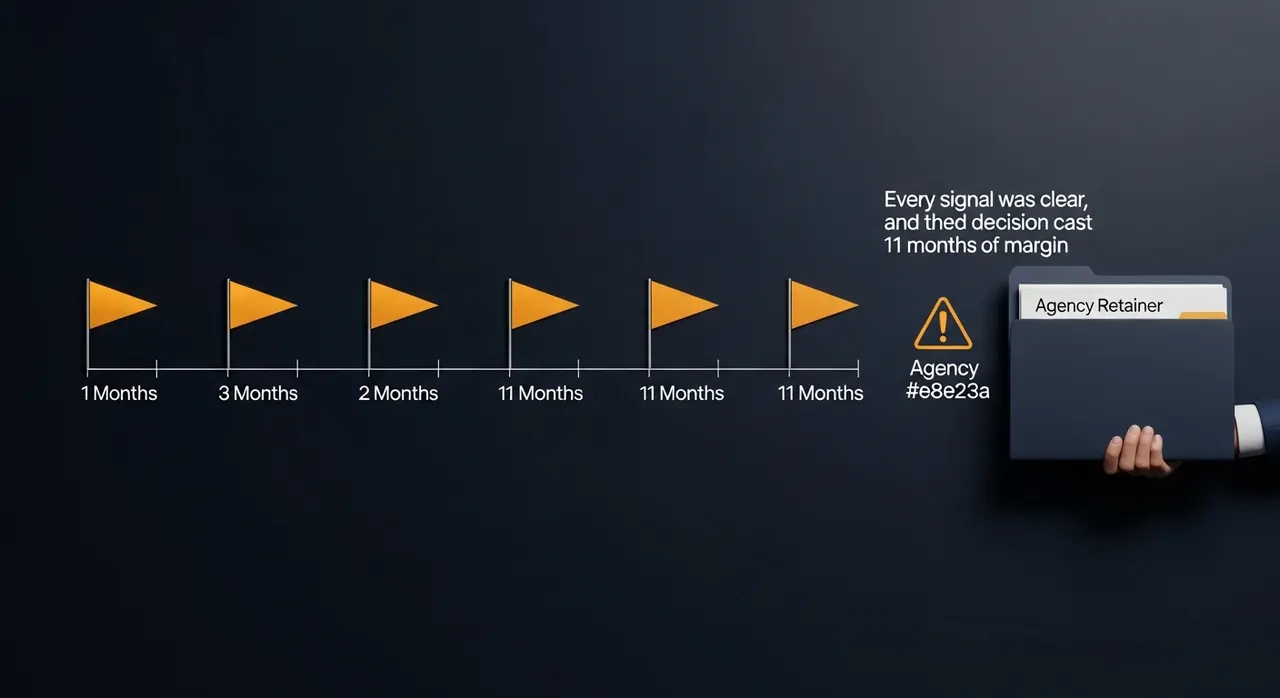
The average underperforming marketing agency relationship in DTC eCommerce runs 11 months past the point at which the data says to terminate. That's not a soft estimate — it's the median lag between the first measurable performance signal and the actual contract termination date across roughly 200 agency-client breakups documented by industry research firms over the last three years. During those 11 months, the brand pays an average of $44,000 to $180,000 in retainers depending on agency tier, and the opportunity cost of underperforming acquisition spend typically runs 1.5x to 2.5x the retainer.
Operators don't stay in bad relationships because they fail to notice the problem. They stay because they can't separate sunk cost ("we've already invested 8 months teaching them the brand") from switching cost ("we'll lose 60–90 days of momentum during transition"). Both feel like reasons to wait. Only one of them is. This article names the five measurable signals that indicate it's mathematically time to leave, regardless of how the relationship feels, and the 60-day exit protocol that protects ad accounts, creative IP, and revenue continuity.
The Default Assumption (and Why It Fails)
The default operator framing for agency performance is qualitative: are they responsive, are they bringing strategic ideas, do they hit deadlines, do we like the account manager. These are real signals, but they are downstream signals — the financial and operational performance has usually deteriorated for several quarters before the qualitative signals become unmistakable. By the time the account manager stops returning calls promptly, the brand has already been losing money on the engagement for 6–9 months.
The framing fails for three structural reasons.
First, agencies are economically incentivized to manage to the floor of the contract, not the ceiling. Most retainer agreements specify deliverables (X campaigns, Y reports, Z creative assets), and once those are delivered, marginal effort produces no marginal revenue for the agency. McKinsey's 2024 marketing services research found that agency hours-per-account decline by 18–30% in years two and three of long retainers, while client revenue and complexity typically increase. The relationship structurally drifts toward under-investment as it ages.
Second, performance attribution gets murkier the longer the relationship runs. After 18 months, neither the brand nor the agency can cleanly say which results came from agency strategy, which came from accumulated brand equity, and which came from market conditions. Both parties have an incentive to claim wins and externalize losses. The dashboard becomes increasingly unreliable as a decision input.
Third, the qualitative signals operators rely on (responsiveness, strategic input, account manager engagement) are designed to mask financial underperformance. Agencies invest in account-management quality precisely because it extends retention through periods of weak results. A responsive, friendly, strategic-sounding agency that produces stagnant or declining performance is the most expensive and longest-lasting form of bad agency relationship.
What the Decision Actually Hinges On
Channel-Level Performance Trajectory, Not Aggregate ROAS
The first decision input is channel-level performance trajectory over a 6-month rolling window, not blended ROAS or month-over-month comparisons. A blended ROAS that holds steady can mask a Meta channel that's deteriorating 20% while a Google Shopping channel improves 25%. The agency's marginal contribution is in the channel they actively manage; the improvement may be coming from algorithm changes or organic shifts they had nothing to do with.
The diagnostic question: in the channels the agency directly manages, has cost-per-acquisition trended flat or downward over the last 6 months relative to the same period 12 months earlier? If yes, the agency is producing baseline performance. If no — and this is what most operators don't measure — the agency is being carried by the rest of the brand. Forrester's 2024 marketing efficiency benchmark found that 38% of DTC brands on agency retainers exhibit declining channel-level CAC efficiency in the agency-managed channels while showing flat blended ROAS, masking the underperformance.
Strategic Output Versus Tactical Execution
The second decision input is whether the agency is operating as a strategic partner or a tactical vendor. Strategic partners produce written quarterly strategy memos that anticipate market shifts, propose tests outside the comfort zone, and reframe problems the brand hasn't articulated yet. Tactical vendors execute the campaigns and report on results.
There's nothing wrong with a tactical vendor relationship at the right price — typically 4–8% of the channel spend they manage, or roughly $4,000–$15,000/month for brands at $1M–$5M GMV. The error is paying strategic-partner rates ($15,000–$40,000/month) for tactical-vendor output. McKinsey's 2024 research identified the average overpayment for tactical-vendor work at strategic-partner rates as $8,400/month for mid-market DTC brands — roughly $100,000 per year of margin destruction with no offsetting strategic value.
The Creative Velocity Floor
The third decision input is creative output rate — the number of new ad concepts produced per month at production quality. The benchmark for paid social channels is 8–15 net-new creative concepts per month for an actively managed account at $30K+ monthly spend. Below 5 new concepts per month, the account is going to fatigue regardless of creative quality, because ad fatigue is a function of impression frequency on individual creative assets, not creative quality alone.
Common Thread Collective's 2024 paid social benchmarks show that DTC accounts running fewer than 5 new creative concepts per month exhibit 12–18% higher CAC by month 4 of any 6-month creative cycle, simply because impression frequency exceeds the fatigue threshold on the existing creative pool. Agencies that promise strategic creative direction but produce 2–3 concepts per month are structurally unable to sustain channel performance, regardless of the strategy quality.
The Cost Reality
The following table builds the all-in cost of staying in an underperforming agency relationship for 11 months — the documented median lag — versus terminating at the first measurable signal at month 4.
| Cost Line | Stay 11 Months | Terminate at Month 4 | |---|---|---| | Retainer (assumed $12,000/month) | $132,000 | $48,000 | | Direct ad-spend underperformance (15% efficiency loss on $50K/month spend) | $82,500 | $30,000 | | Opportunity cost of strategic stagnation | $40,000 | $14,500 | | Transition cost (one-time) | $0 | $18,000 | | Total 11-month cost | $254,500 | $110,500 | | Savings from early termination | — | $144,000 |
The opportunity cost line — strategic stagnation — is the one that's hardest to measure but largest in compounding effect. A brand running paid acquisition spend without strategic creative refresh, audience expansion testing, or new-channel exploration loses ground to competitors who are doing those things. The cost of not testing TikTok in 2024 was small in 2024 and significant by mid-2025 for brands whose competitors had built TikTok pipelines while the brand's agency was running a familiar Meta playbook.
The transition cost — $18,000 in the model above — accounts for the 60–90 day setup period for a new agency or in-house team. Most operators overestimate this number by 2–3x because they imagine total disruption. In practice, with a properly executed exit protocol (covered below), the actual disruption window is 30–45 days of partial coverage, not 90 days of zero coverage.
The single most important number in this table is the savings from early termination relative to the transition cost: $144,000 saved against $18,000 spent, a roughly 8:1 ROI on making the kill decision at the math signal rather than at the qualitative signal.
The Trade-Off Map
Stay and Try to Renegotiate
The benefit of renegotiation is that you preserve continuity and the institutional knowledge the agency has accumulated about the brand. The cost is time: renegotiations typically run 6–10 weeks (proposal, scope reduction, pricing reset, new SOW), and the relationship dynamics rarely improve substantively. Forrester's 2024 research found that 71% of DTC brands that renegotiated underperforming retainers terminated within 12 months anyway, having spent another $36,000–$110,000 on the relationship in the interim. Renegotiation is rational only when there are specific structural changes (new senior account lead assigned, scope shift to capabilities the agency demonstrably has) that can be measured at 90 days.
Switch to a New Agency
The benefit of switching agencies is that you reset to current best practices and avoid the in-house build-out cost. The cost is the discovery cycle — 30–60 days of new-agency learning before performance stabilizes — plus the structural risk that the new agency exhibits the same drift pattern by month 18. Brands that switch agencies repeatedly without addressing the structural reasons (insufficient internal data ownership, vague scope definition, weak performance review process) typically cycle through 3–4 agencies in 5 years and produce average underperformance vs. equivalent in-house teams of 12–22% on channel CAC efficiency.
Bring It In-House
The benefit of in-house is structural alignment of incentives — your team works only on your brand and reports to operators who feel the margin impact directly. The cost is fixed-cost commitment ($85,000–$160,000 fully-loaded annual cost for a senior paid media specialist, plus tooling) and the operational burden of recruiting, training, and retention. McKinsey's 2024 marketing services data identifies the in-house break-even point at roughly $30,000/month of channel spend for paid social and $50,000/month for paid search — below those thresholds, the fixed cost of in-house headcount typically exceeds the savings from removing agency margin. The decision to build an in-house team is inseparable from team structure decisions about hiring sequence and role definition. Above those thresholds, in-house consistently produces 18–30% better channel CAC efficiency than retainer agencies for brands willing to invest in recruiting quality.
When to Fire (Specific Triggers)
Trigger 1: Channel-Level CAC Has Trended Flat or Up for Six Months in Agency-Managed Channels
Pull the last 12 months of channel-level CAC data for every channel the agency directly manages. If the rolling 3-month average has been flat or rising for the last 6 months, the agency is not producing the optimization they're paid to produce. Account for seasonal effects by comparing year-over-year for the same months. If the same trend appears, the kill signal is firing.
Trigger 2: Creative Velocity Has Run Below 5 New Concepts Per Month for a Full Quarter
Audit your ad library for the last 90 days. Count net-new creative concepts (not variations of the same concept). If the count is below 15 across the quarter — averaging fewer than 5 per month — the agency is structurally unable to combat ad fatigue regardless of creative quality. This is a kill signal because it predicts the next quarter's CAC deterioration with high reliability.
Trigger 3: No Written Strategic Memo Has Been Produced in the Last Two Quarters
Check whether the agency has produced an unsolicited written strategic recommendation in the last 6 months — a memo that anticipates a market shift, proposes a non-obvious test, or reframes a metric the brand should track. If the answer is "they discussed it on the call but didn't write anything," the agency has drifted into tactical-vendor mode and is being paid strategic-partner rates.
Trigger 4: The Account Lead Has Been Replaced Twice in 12 Months
Account lead turnover is structurally destructive to agency performance because each transition resets the brand-knowledge curve and adds 30–60 days of relearning. Two transitions in 12 months means the brand has had effective service for 4–6 months out of 12, while paying for 12. This is a kill signal regardless of any other performance metric, because the agency cannot deliver continuity.
Trigger 5: The Agency Has Resisted Granting Direct Account Ownership
If the agency operates ad accounts under their MCC/MCA (manager account) without granting the brand admin-level access, or refuses to share creative source files in the contract, the relationship is structurally hostile to a future transition. This isn't a performance signal — it's a leverage signal. Agencies that protect transition leverage are doing so because they expect the relationship to end and want to extract maximum cost from the exit.
What Operators Get Wrong Most Often
Mistake 1: Confusing the Sunk Cost of the Relationship With the Switching Cost
The most common decision error is conflating the time and money already spent with the cost of changing. "We've trained them on the brand for 14 months" is a sunk cost — it's gone regardless of whether you stay. The relevant comparison is forward 12 months under the current agency vs. forward 12 months under a new agency or in-house team, with the transition cost amortized into that comparison. When framed correctly, the math almost always favors transition once the kill signals are firing, because the underperformance compounds at a higher rate than the one-time transition cost.
Mistake 2: Waiting Until the End of the Contract to Make the Decision
Most operators wait until the annual renewal date to evaluate the relationship. This converts a math decision into a calendar decision and adds an average of 4–9 months of underperformance to the lag between signal and termination. Performance reviews should run on a rolling 90-day cadence with predefined thresholds (the five triggers above), not on a contract-renewal cadence. When the math signal fires, the termination process should begin within 30 days, not at the next renewal cycle.
The Verdict
Fire the agency the day a measurable kill signal fires — not when the relationship feels bad, not at contract renewal, not when cash gets tight. Channel CAC trending flat for 6 months, creative velocity below 5 new concepts per month, no written strategic output in 6 months, two account-lead transitions in 12 months, or refusal to grant direct account ownership: any one of these is a kill signal. This week, run the channel-CAC trajectory check on the agency-managed channels and the creative-velocity audit for the last 90 days. If either signal fires, start the 60-day exit protocol — secure ad account admin access, request creative source files, identify the replacement (agency or in-house), and execute the handoff in two 30-day stages rather than one disruptive cutover.