By Diosh — Founder, AHAeCommerce | eCommerce decision intelligence for $50K–$5M GMV operators
A 5%-back points program on a brand running 38% gross margin needs to lift repeat purchase frequency by 17% just to break even on the discount liability — before counting the platform fee, the merchandising team time, and the customers who would have purchased anyway. Most operators launching a loyalty program have never run this calculation. They install Smile.io or Yotpo, set point values that feel "generous enough," and assume the program will pay for itself because retention is intuitively cheaper than acquisition.
It doesn't pay for itself by default. A loyalty program is a structural discount applied to your most valuable customer segment — the people who were already going to come back. Whether it produces incremental revenue or simply transfers margin to existing repeat buyers depends entirely on a calculation almost nobody runs before launch.
The Default Assumption (and Why It Fails)
The standard pitch for loyalty programs treats retention as inherently profitable: "Acquiring a new customer costs 5x more than retaining an existing one" (Harvard Business Review, 2014). That comparison is true on average and useless as a decision input. It doesn't tell you whether your specific loyalty mechanic — at your specific point structure, on your specific margin profile, against your specific customer base — produces incremental purchases or just discounts purchases that would have happened anyway.
The failure mode is almost always the same. A founder evaluates the program at the aggregate level: "Loyalty members spend 2.3x more than non-members." That number is real and it is also a selection-bias artifact. Loyalty members enroll because they were already high-frequency buyers. The program didn't create the behavior; it labeled it. Bain & Company's customer loyalty research has documented this self-selection effect across categories for two decades (Bain & Company, The Loyalty Effect, 2003).
The relevant metric is not what members spend versus non-members. It is the incremental purchase frequency the program produces — measured against a control group of comparable buyers who were never offered enrollment.
What the Decision Actually Hinges On
The Discount Rate Hidden Inside Your Point Structure
Every points program is a discount in disguise. A "1 point per $1 spent, 100 points = $5 off" program is a 5% discount on all future purchases by enrolled members — paid out only when redeemed, but accrued as a liability the moment it is earned. The redemption rate determines whether the accrued liability becomes a realized cost. Industry redemption rates run 50–70% for active programs and 20–30% for inactive ones (Bond Brand Loyalty, Loyalty Report, 2023).
At a 60% redemption rate, your effective program discount is 3% of member revenue. At an 80% redemption rate — common for well-designed programs with low redemption friction — it is 4%. This is the floor on what the program costs you. The ceiling adds platform fees ($50–$600/month depending on tier), referral payouts if your program includes them, and the merchandising margin you forgo by discounting your full catalog rather than only items you wanted to clear.
The Counterfactual Purchase Problem
The cost is real and observable. The benefit — incremental purchase frequency — is almost never measured rigorously, because doing so requires withholding the program from a control group of comparable customers. Most brands don't run this test. They compare member revenue to non-member revenue and call the difference "loyalty lift," which is the wrong calculation by an order of magnitude.
A properly designed measurement isolates the program effect from selection bias. The cleanest method: enroll customers automatically after their second purchase, then compare the third-purchase rate of enrolled customers (treatment) to the third-purchase rate of a randomly held-out 10% (control) over a 6–12 month window. If the treatment cohort's third-purchase rate is 5 percentage points higher than control, you have a real, measurable lift. If it's within 1 point, you have a program that costs money and produces no incremental behavior.
The Margin Sensitivity Almost Nobody Models
The break-even repeat purchase lift required to justify a program scales inversely with gross margin. A brand at 60% gross margin can absorb a 4% effective discount with a modest 7% repeat purchase lift. A brand at 35% gross margin needs an 11% lift on the same discount structure to break even. A brand at 25% margin needs a 16% lift — which is almost never achievable from a points program alone.
This is the calculation most operators skip. It is also why loyalty programs work well for jewelry, beauty, and specialty food (high margin) and work poorly for apparel basics, supplements, and electronics accessories (mid-to-low margin). The same program mechanic produces different unit economics depending on what you sell.
The Cost Reality
The following table shows the annual program cost and break-even repeat purchase lift required for a 1,000-active-member loyalty program at varying gross margins and discount structures. Assumptions: $85 AOV, members average 2.4 purchases/year baseline, 60% redemption rate.
| Margin | Discount Rate | Annual Member Revenue | Effective Discount Cost | Platform Fee | Total Annual Cost | Break-Even Lift Required | |---|---|---|---|---|---|---| | 60% | 3% (5pt/$1, $5/100) | $204,000 | $6,120 | $3,000 | $9,120 | 7.4% | | 60% | 5% (5pt/$1, $5/60) | $204,000 | $10,200 | $3,000 | $13,200 | 10.8% | | 45% | 3% | $204,000 | $6,120 | $3,000 | $9,120 | 9.9% | | 45% | 5% | $204,000 | $10,200 | $3,000 | $13,200 | 14.4% | | 35% | 3% | $204,000 | $6,120 | $3,000 | $9,120 | 12.7% | | 35% | 5% | $204,000 | $10,200 | $3,000 | $13,200 | 18.5% | | 25% | 5% | $204,000 | $10,200 | $3,000 | $13,200 | 25.9% |
A 25%-margin brand running a 5%-back program needs to lift member repeat purchase frequency by 26% to break even. The published average lift across well-run loyalty programs is 8–15% (Antavo, Global Customer Loyalty Report, 2024). The math does not support running a generous points program at thin margins. Either the discount has to come down, the margin has to be improved at the product level, or the program has to be replaced with a non-discount retention mechanic (early access, VIP support, content) that costs less per member.
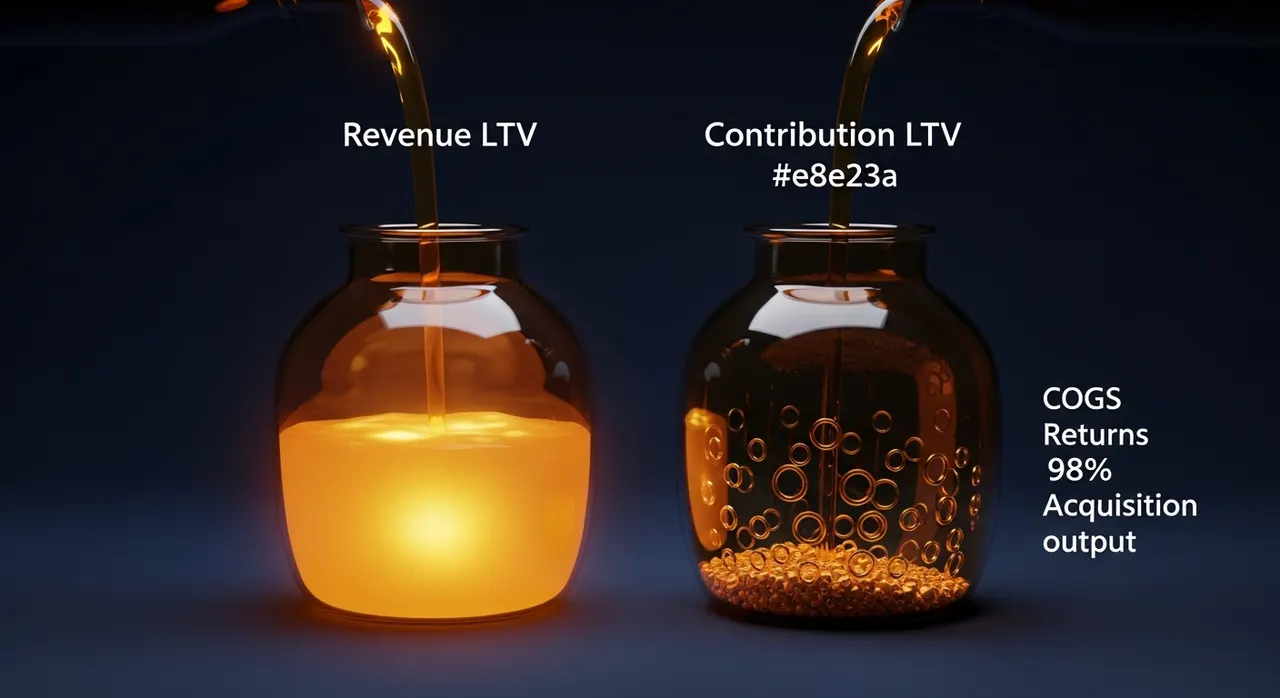
A reference point worth keeping: the contribution margin gap between gross and operating margin determines what you can actually afford to give back at the program level — gross margin is the wrong number for this calculation if your variable fulfillment and payment processing costs are high.
The Trade-Off Map
Points Programs (The Default Choice)
Points programs are the most common loyalty mechanic and the most expensive to operate per unit of behavioral change. They convert into a structural discount the moment a customer earns enough to redeem. They are easy to launch — Smile.io, Yotpo, and LoyaltyLion all offer turn-key setups — and easy to mismeasure. The category works best for brands above 50% gross margin with replenishable products that have natural reorder cycles (beauty, supplements, pet food). It works worst for brands selling considered, infrequent purchases (furniture, appliances) where the points value erodes between purchases.
Tier-Based Programs Without Discount Liability
A tier program that grants status (early access, free shipping, priority support, exclusive products) without granting a points-redeemable discount has fundamentally different economics. The variable cost is shipping subsidy and operational complexity, not a discount liability. The leverage point is psychological — VIP status creates retention behavior at a fraction of the discount cost.
The trade-off: tier programs require infrastructure your operation may not have. Free shipping above a threshold is straightforward. Priority customer support requires staffing capable of identifying and routing VIP tickets. Exclusive product access requires inventory allocation discipline. The program is cheaper per member but more expensive to design and maintain — and the operational requirements rule it out for brands with lean teams.
Cashback Programs (Direct Revenue Share)
A cashback program returns a percentage of purchase value to the customer as account credit or PayPal/store-credit payout. It is mathematically equivalent to a points program but psychologically less effective — research from the Journal of Consumer Research finds that points-based currencies produce 12–18% higher engagement than equivalent cashback (Hsee, Yu, Zhang, & Zhang, 2003). The reason is that points feel like an earned asset; cashback feels like an automatic discount. The same financial value produces less behavioral lift.
Cashback works for B2B and high-AOV ($300+) categories where the redemption psychology is less important than the financial transparency. It works poorly for impulse and discretionary purchase categories where the psychological hook of an earned currency drives the repeat behavior.
Subscription-Adjacent Mechanics (Replenishment + Loyalty)
The mechanic with the strongest ROI evidence is replenishment subscription with embedded loyalty benefits — auto-ship at 10–15% discount with priority support and free shipping. This works because it converts loyalty from a behavioral prompt into a structural reorder, which produces measurable purchase frequency lift (typically 30–60% on enrolled customers, per Shopify's subscription analytics) at a known discount cost.
The trade-off is that replenishment requires a product that consumes on a predictable cycle. Coffee, supplements, pet food, beauty staples — all candidates. Apparel, accessories, home goods — not candidates. If your catalog doesn't support replenishment, this option is not available regardless of how well it works for other brands.
When to Act (Specific Triggers)
Trigger 1: Run the Break-Even Calculation Before Any Launch Decision
If you are considering launching a loyalty program, do this before signing up for any platform: calculate (gross margin × member share of revenue) − (planned discount rate × redemption rate × member revenue) − annual platform fee. Divide the negative remainder by gross margin × member revenue to get the repeat purchase lift required to break even. If the number exceeds 12%, the program is unlikely to be profitable on the published industry averages. Redesign the mechanic before launch, not after.
Trigger 2: Audit Existing Program at 12-Month Mark
If your loyalty program is more than 12 months old and you have never measured incremental purchase frequency against a control group, that audit is the highest-leverage analytics work you can do this quarter. The simplest version: pull all customers who enrolled in the program during a specific month, identify a matched cohort of customers from the same month who did not enroll, and compare their 12-month repeat purchase rates. If the difference is below 5 percentage points, the program is likely cost-negative on the math above.
Trigger 3: Renegotiate Platform Fees at $500K+ Member Revenue
Loyalty platforms scale their pricing in steps. At $500K+ in annualized member revenue, the platform fee tiers usually become negotiable, particularly if you are willing to commit to a 12-month term. A 30% fee reduction at this stage typically saves $1,500–$3,500/year, which moves the break-even math meaningfully for thin-margin brands.
Trigger 4: Migrate to Tier or Replenishment if Repeat Lift is Sub-5%
If your audit shows sub-5% incremental lift from a points program and your category supports replenishment, migration to a subscription-adjacent loyalty mechanic typically improves unit economics within 6 months. If your category doesn't support replenishment but does support exclusive content or experience benefits, migration to a non-discount tier program reduces the discount liability while preserving the psychological hook.
What Operators Get Wrong Most Often
Mistake 1: Comparing Members to Non-Members and Calling It Lift
The most common reporting failure is using member-vs-non-member spending as the measure of program performance. Loyalty members spending more than non-members is a near-tautological observation — the customers who opt into a program are the customers most engaged with the brand. The relevant comparison is members today vs. comparable customers before the program existed, or members vs. a randomly held-out control. Anything else is selection-bias revenue, not program revenue.
Mistake 2: Setting Point Values Without Modeling Liability
The second mistake is setting the points-to-dollar exchange rate without modeling the accrued liability. A program at 10 points per $1 with 100 points redeemable for $5 looks generous and produces a 5% effective discount at 100% redemption — far above what most brands intend. If you set point values intuitively rather than backing them out from a target discount rate, you almost certainly designed in a higher effective discount than your margin can support.
Mistake 3: Treating Loyalty as a Replacement for Brand Differentiation
The third mistake — common at the $1M–$3M GMV transition — is launching a loyalty program as a response to declining repeat purchase rates without addressing the underlying cause. If the repeat purchase decay is driven by product fit, competitive substitution, or merchandising staleness, no loyalty program will reverse it. Loyalty programs amplify existing repeat behavior; they do not create it where none exists. Brands that launch loyalty as a churn defense without first diagnosing the cause typically see modest first-quarter engagement followed by a return to the original decay curve, now compounded by the program's discount cost.
The Verdict
Loyalty programs are a margin tax that produces incremental revenue only when the lift exceeds the break-even threshold set by your gross margin and discount rate. For brands above 50% gross margin in replenishable categories, well-designed programs typically clear that threshold. For brands below 35% margin in non-replenishable categories, they typically do not.
This week: Pull last 12 months of orders, identify your loyalty program members and an equivalent cohort of non-members matched on first-purchase date and category, calculate the 12-month repeat purchase rate for each group. If the gap is below 5 percentage points, your program is almost certainly cost-negative — and the next decision is whether to redesign the mechanic, renegotiate the platform fee, or sunset the program entirely.