By Diosh — Founder, AHAeCommerce | eCommerce decision intelligence for $50K–$5M GMV operators
A subscriber clicks cancel. Your retention flow fires a 20% discount before they finish reading the page. It feels like a win — you saved them. But on a $40/month replenishment subscriber, that 20% is $8 of margin per cycle, and if they stay another ten months you just handed back $80 to a customer who, in most cases, was going to stay anyway. This is a decision piece for operators who treat the save offer as a reflex instead of a routed choice. The question is not whether to save a cancelling subscriber. It is which cancel reason makes a discount the right tool — because three of the four common reasons don't, and the blanket discount you fire at all of them is quietly teaching your best customers that the cancel button is a discount button.
The Blanket Save Offer Is a Margin Leak Disguised as a Win
The reflex looks rational from the dashboard. Churn ticks up, you bolt a discount onto the cancel flow, and the save rate climbs. The number you're optimizing — percentage of cancellations reversed — goes green. What that number hides is the denominator problem: a meaningful share of the people clicking cancel were never going to leave permanently. They were skipping, reconsidering, or fat-fingering the button. You handed a discount to people who needed nothing, and you booked it as a save.
Run the arithmetic on a real cohort. A $1.8M GMV coffee-replenishment brand ships at $42/month with a roughly 60% gross margin, so about $25 of margin per cycle. A blanket 25% save discount drops that to roughly $14.50 of margin — a $10.50 hit every single month the discount persists. If even 40% of "saved" subscribers would have stayed without any offer (a conservative read of most cancel-flow data), you're not saving those customers. You're paying a $10.50 monthly ransom to customers who weren't actually leaving, and the offer never expires because nobody builds the discount to roll off.
Industry retention research has made this trade-off concrete for years. Paddle's ProfitWell work on subscription retention has repeatedly shown that discount-led save tactics improve a short-term save metric while degrading the lifetime value of the retained base, because the discounted cohort renews at a lower price and churns again later anyway. The save offer doesn't fix the underlying reason the customer reached for cancel — it just buys a deferral and finances it out of your margin.
This is the core of churn economics: a save is only a save if the customer would otherwise have been permanently lost AND the cost of retaining them is below the margin you recover. A blanket discount fails both halves of that test for most of the people it touches. You can't see the failure on the save-rate chart, which is exactly why the reflex survives.
The Reverse Incentive: You're Training Your Best Customers to Game You
Here is the part the save-rate dashboard will never show you, and it's the most expensive part. When the discount is automatic and unconditional, sophisticated customers learn the pattern. Your highest-LTV subscribers — the ones who've been around eighteen months, who pay attention, who talk in communities — figure out that the cancel flow is a coupon dispenser. They don't want to leave. They want the discount. So they click cancel, collect their 25%, and continue exactly as before, now permanently at a lower price.
This is a reverse incentive, and it compounds. The behavior you reward is the behavior you get more of. A brand that runs blanket save discounts long enough discovers that "intent to cancel" stops correlating with actual departure risk and starts correlating with price awareness. Your most engaged, most loyal, most valuable customers become the ones most likely to trigger the save offer — not because they're at risk, but because they've learned the game. The tool you built to reduce churn is now actively eroding the margin of the subscribers who were never going to churn.
The dynamic mirrors what Harvard Business Review has documented about chronic discounting in retail and subscription contexts: discounts that are predictable become an entitlement, reset the customer's reference price downward, and condition demand to wait for the markdown rather than pay full freight. Once your reference price is broken, you can't easily put it back. The subscriber who got 25% for clicking cancel will not calmly accept full price next cycle — they'll click cancel again.
This is the same trap explored in discount dependency: every discount you make reliable becomes a discount you can't withdraw without feeling like a price increase to the customer. A blanket save offer is the most dangerous version because it's triggered by the customer, on their schedule, with no cost to them for pulling the lever. You've built a machine that converts loyalty into discount-seeking.
Cancel Reason Is the Only Variable That Matters
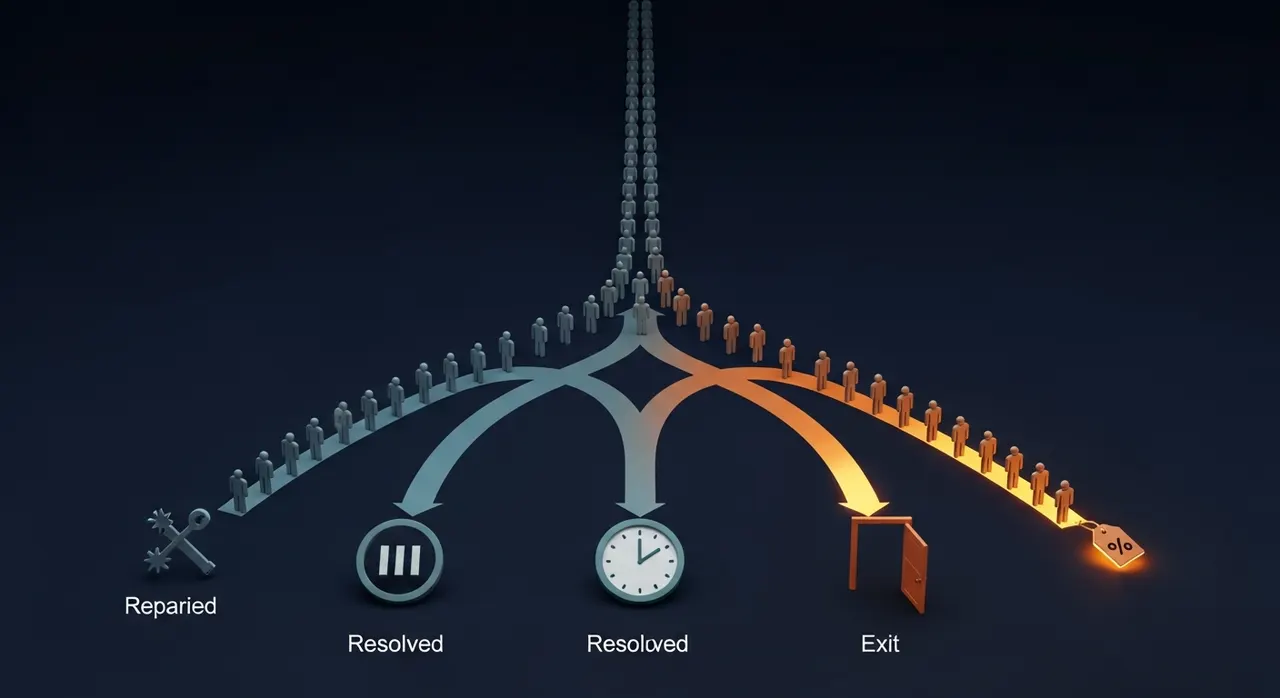
The fix is not a better discount. It is refusing to make the discount the default response, and routing the decision on the one variable that actually predicts whether a discount is the right tool: why the customer is cancelling. There are four common reasons, and they require four different responses. Only one of them is worth money off.
Dissatisfied — Fix or Replace, Never Discount
The customer is leaving because the product didn't work, arrived damaged, or didn't match expectations. A discount here is the wrong instrument entirely — it asks them to pay (less) for an experience they've already told you failed. The correct response is resolution: replace the item, fix the issue, send a one-time make-good, or escalate to a human. Discounting a dissatisfied customer signals that you'd rather pay them to tolerate a defect than fix it, which deepens the dissatisfaction. Solve the problem and many of these subscribers stay at full price, because the problem — not the price — was the reason.
Too Much Product — Skip, Delay, or Reduce Frequency
This is the most common replenishment cancel reason and the one most often answered with a needless discount. The customer's bathroom shelf is full. They don't have a price objection — they have a cadence objection. Offering money off makes the over-supply problem worse and trains the discount-seeking behavior on top. The right tool is operational: let them skip a cycle, delay the next shipment, or stretch the interval from monthly to every six weeks. Recharge's subscription-commerce data has consistently identified flexible skip-and-delay controls as a primary churn-reduction lever for replenishment brands — and it costs you nothing in margin. You keep the subscriber and the full price.
Price-Sensitive — Discount ONLY If CLV Justifies It
This is the single reason where a discount can be the correct decision — and even here it's conditional, not automatic. The customer genuinely cannot or will not pay the current price. A targeted offer can retain them, but only if the discounted lifetime value still exceeds what it would cost to re-acquire an equivalent customer. That calculation has to be real, not assumed. Pull the actual numbers from your customer LTV reality and weigh them against acquisition cost. If a discounted subscriber still clears your retention threshold, save them. If the discount drags their CLV below replacement cost, the honest answer is to let them go.
Need Met — Let Them Go Gracefully
The customer solved the problem your product addressed. They lost the weight, finished the renovation, the baby grew out of the size. No discount retains someone who no longer has the need — it just adds a low-margin, soon-to-churn subscriber to your base and corrupts your retention data. Let them go cleanly, capture the reason, and leave the door open for re-subscription later. A graceful exit from a satisfied customer is worth more than a discounted save from an unsatisfiable one.
The Decision Math: When a Discount Actually Pays
Strip it to the formula an operator can run at the cancel event. A save discount is justified only when: the customer is genuinely at risk of permanent loss, AND a non-discount tool (fix, skip, delay) cannot resolve their reason, AND the discounted lifetime value still exceeds the cost to replace them. Three conditions. A blanket offer ignores all three.
Make it numerical. That $42/month coffee subscriber at ~$25 margin: if a 25% discount retains them for twelve more months, you recover roughly $174 in discounted margin ($14.50 × 12) versus $0 if they leave permanently — a clear win, if they were truly leaving. But McKinsey's research on subscription e-commerce churn has found that a large fraction of cancellations are reason-specific and resolvable without price concessions, meaning the "$0 if they leave" assumption is wrong for most of the flow. For a skip-able or fixable subscriber, the comparison isn't $174 versus $0. It's $174 of given-away margin versus $300 of full-price margin you'd have kept by offering a skip. The discount loses.
The asymmetry is the whole point. When you discount the wrong reason, you don't break even — you actively destroy value relative to the free tool that would have worked better. This connects directly to retention vs acquisition economics: retention is only cheaper than acquisition when the retention tool costs less than the margin it preserves. A discount fired at a customer who'd have stayed for free is retention spend with negative return.
And the structural risk compounds it. As covered in the subscription model trap, a subscription base that depends on save discounts to hold its numbers isn't a retained base — it's a deferred churn problem wearing a healthy save rate. The math only works when the discount is the exception you reach for deliberately, not the reflex you fire automatically.
Build the Cancel-Reason-Gated Save Flow This Week
The action is concrete and you can ship it without a platform migration. Replace the single blanket discount with a branching flow that asks the cancel reason first, then routes to the matched response. Dissatisfied routes to fix-or-replace and a human if needed. Too-much-product routes to skip, delay, and frequency controls — no discount field anywhere on that branch. Need-met routes to a graceful exit with reason capture and a re-subscribe path. Only the explicit price branch surfaces a discount, and even that one is gated on a CLV check, capped in duration so it rolls off, and rate-limited so the same customer can't harvest it repeatedly.
Then instrument it honestly. Stop reporting a single save rate. Report saves by reason and by tool, and track whether discounted saves churn again within ninety days. The first time you see your highest-LTV cohort over-represented in the price branch, you've found the customers who learned to game the old flow — and you'll understand why the blanket discount felt like a win while it was bleeding you. The decision was never whether to save them. It was which reason earned the spend. Three of four don't.