By Diosh — Founder, AHAeCommerce | eCommerce decision intelligence for $50K–$5M GMV operators
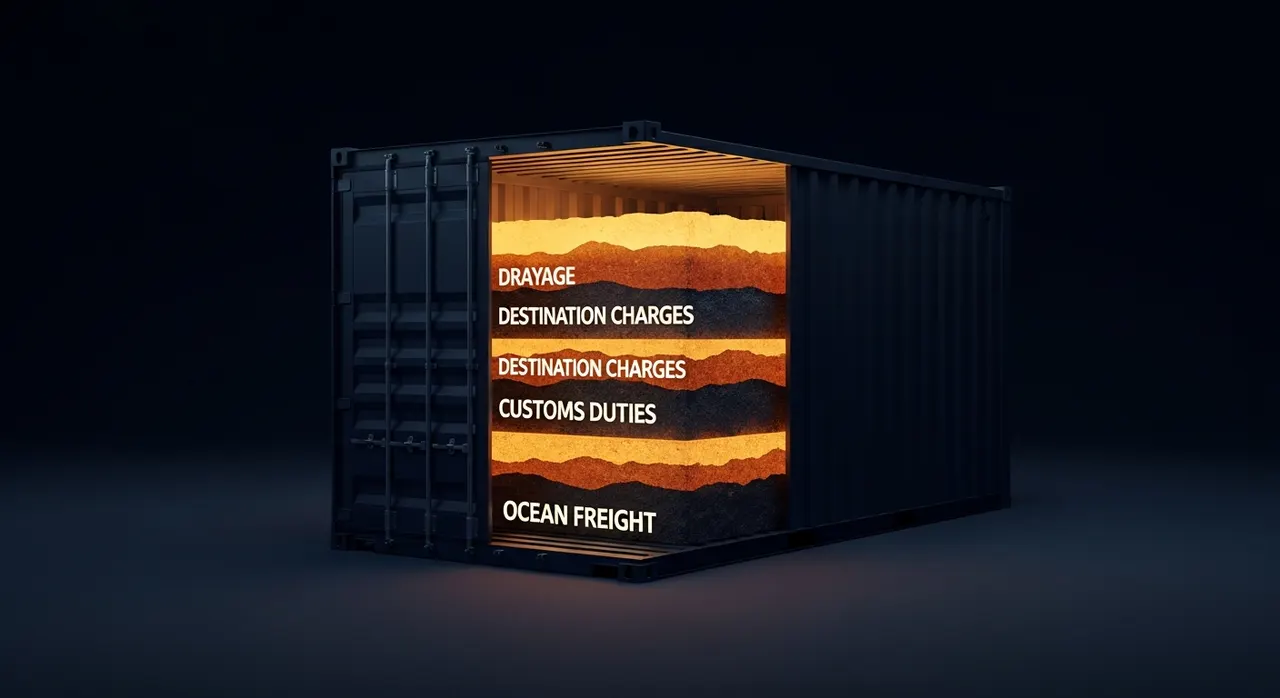
A product your factory invoices at $12 may have a real landed cost of $19.80 after ocean freight, customs clearance, import duties, drayage, and 3PL receiving. Add a 20–25% tariff increase and that landed cost reaches $22.20 or higher. If your retail price was set to produce a 55% margin at $12 landed, it now produces a 41% margin at $22.20. If your channel is price-constrained — Amazon, where price parity enforcement caps your ceiling, or a wholesale account where the price sheet was set 12 months ago — that margin doesn't recover by raising the price.
The operators most exposed to tariff volatility are not the ones importing the highest-tariff items. They are the ones whose pricing architecture cannot absorb cost variance without destroying margin or losing channel position. The question is not "how high is my tariff rate?" It is "how much cost variance can my current price ceiling absorb before the SKU becomes unprofitable to sell?"
The Default Assumption (and Why It Fails)
The standard operator response to tariff news follows a triage pattern: talk to the supplier about price reduction, evaluate freight routing alternatives, add a temporary surcharge if the customer relationship permits it, and assume the situation will normalize.
This pattern treats tariffs as a freight and procurement issue — a cost line that gets managed by negotiating harder with supply chain partners, the same way operators respond to fuel surcharges or container rate spikes. It fails for two structural reasons.
First, tariff changes operate on a different timeline than freight cost changes. Ocean freight rates respond to spot markets and normalize within 3–6 months in most cycles. Tariff policy changes — particularly major ones like the end of de minimis treatment or Section 301 duty rate revisions — operate on political and legislative timelines that don't respond to supply chain pressure. An operator who managed the 2021–2022 freight rate spike by waiting it out is applying the wrong model to a tariff-rate change that may be structural rather than cyclical.
Second, tariffs don't affect all SKUs in the same way, and the operator who responds with a blanket supplier price negotiation misses the SKU-level variance that determines which products remain viable and which don't. A 25% tariff increase on a product you import at $6 landed and sell at $15 has a very different impact than the same 25% increase on a product you import at $22 landed and sell at $29. The first product can absorb the cost shift; the second may require a price increase that the market won't support.
What the Decision Actually Hinges On
The Price Ceiling vs. Cost Floor Relationship
Every SKU has a price ceiling — the maximum price the market will support given competitive alternatives — and a cost floor — the minimum margin required for the product to be worth selling. Tariff volatility creates risk when the gap between the price ceiling and cost floor is narrow.
A product with a $30 price ceiling and a $12 landed cost (before new tariffs) has a $18 gross contribution buffer. A 25% tariff increase adds $3 to landed cost, reducing the buffer to $15. The product remains viable.
A product with a $30 price ceiling and a $23 landed cost before tariffs has a $7 gross contribution buffer. The same 25% tariff increase adds $5.75, reducing the buffer to $1.25. The product is technically still profitable, but any additional cost variance — return rate, marketplace fee increase, freight surcharge — makes it a margin drain.
The dangerous SKUs are the ones with narrow price-to-cost gaps, not necessarily the ones with the highest tariff rates. A 5% tariff increase on a $22 landed cost product with a $25 ceiling is more dangerous than a 25% tariff increase on a $10 landed cost product with a $40 ceiling.
De Minimis: The Structural Change for Low-Value Importers
For operators who used direct-to-consumer shipping from Chinese factories — whether Shein-style fast fashion, Temu-style discounted goods, or branded DTC operators using Chinese 3PLs to ship direct — the end of de minimis treatment enforced by CBP in 2025 represents a structural change, not a cyclical one.
Previously, packages valued at $800 or less could enter the U.S. without formal customs clearance or duty assessment. This made direct-from-factory D2C shipping viable for low-price, low-margin products because the cost structure — product + air freight or small parcel international shipping, no import duty — was competitive with domestic fulfillment. With de minimis eliminated for Chinese-origin goods, every shipment now requires formal entry and duty assessment regardless of value.
The economics shift is specific: a $15 retail product with a $2 factory price, $3 air freight, and zero import duty (de minimis) had a landed cost of $5. With de minimis eliminated and a 25% import duty applied, the landed cost rises to $5.50 (duty on the $2 factory value) plus any customs clearance and brokerage cost. For many low-price, high-volume products, this moves the break-even point past the viable retail price for the U.S. market.
This is a channel viability question, not a margin optimization question. The correct response is SKU viability modeling under the new cost structure, not supplier negotiation.
Inventory Timing and Cash Exposure
Tariff changes that are announced but not yet in effect create a specific cash management decision: front-load inventory before the tariff takes effect, accepting higher inventory carrying cost and working capital exposure, or maintain normal inventory cadence and absorb the higher cost post-implementation.
Front-loading is only rational when: (1) the storage cost of carrying 3–6 months of extra inventory is less than the tariff cost difference, (2) the working capital required for the front-load is available without compromising operations, and (3) the tariff implementation timeline is reliable enough to plan around.
The operators who front-loaded inventory before tariff implementations that were then delayed, paused, or partially rolled back faced a different problem: excess inventory at higher carrying cost, slower cash conversion, and reduced flexibility to respond to demand shifts. Front-loading during tariff uncertainty is a leveraged bet on policy implementation timing.
The Cost Reality
A mid-market operator importing $800K in product annually at an average landed cost of $18 per unit, with an average tariff exposure of 20% of that landed cost, faces a $32K annual tariff cost under normal conditions. A 25% rate increase adds $8K to annual tariff costs at the same volume — manageable at the portfolio level.
The portfolio-level math obscures the SKU-level exposure. Within that $800K of imports, there may be 15 SKUs where the tariff rate is 45% of landed cost rather than 20%, and where the retail price has limited ceiling headroom. Those 15 SKUs may represent $120K of annual import value — and a 25% tariff increase on their specific rates adds $13.5K in cost on $120K of goods, with no pricing flexibility to offset it.
The operators who build their tariff response at the portfolio level and miss the SKU-level concentration are the ones who are surprised when the P&L shows the impact. The variance between "our average tariff exposure is 20%" and "our highest-exposure SKUs are at 45%" is where the real risk lives.
The Landed Cost Scenario Model
The practical tool for navigating tariff uncertainty is a three-scenario landed cost model by SKU:
Base case: current tariff rate, current freight cost, current supplier price. This is what the margin model was built on.
Adverse case: tariff rate increased by the current proposal or announced range (e.g., +25%), current freight, supplier price negotiation reducing factory cost by 5%. What is the contribution margin at the current retail price? What is the new retail price required to maintain margin target?
Emergency case: tariff rate at maximum announced range, freight elevated 15% (acute demand spike from pre-tariff front-loading by the market), no supplier concession available. At what retail price does the product break even? Is that price achievable in the current channel? If not, what is the exit or pivot path?
Any SKU where the emergency case produces a required retail price above the current ceiling, or a contribution margin below the acceptable floor, is a structurally at-risk SKU that warrants either sourcing diversification, product reformulation for domestic supply, or planned exit.
The Trade-Off Map
Domestic or Near-Shore Sourcing
Moving production to domestic U.S. manufacturing, Mexico (USMCA), or Vietnam (lower tariff exposure) eliminates or reduces the tariff variable. The cost is higher unit cost — domestic manufacturing typically runs 30–60% higher per unit than comparable Chinese production for most consumer goods categories — and the lead time to establish a new supplier relationship runs 6–18 months depending on product complexity.
For operators with a 3–5 year planning horizon and a brand positioned on domestic manufacturing or supply chain transparency, the move makes strategic and economic sense. For operators who need to respond to a tariff change within 6 months, it is not a near-term solution.
Price Increase and Channel Mix
Raising retail prices to offset tariff costs is the cleanest margin protection if the market supports it. The constraint is channel-specific: DTC and owned channels have the most pricing flexibility; marketplace channels have price parity requirements or competitive constraints that cap ceiling pricing. Wholesale relationships have price sheets with renegotiation friction.
Channel mix also matters: operators who generate 80% of volume through Amazon, where price competition is visible and real-time, have less pricing flexibility than operators with 50% DTC and an email list that provides buffer against real-time price comparison.
SKU Rationalization
The strongest tariff response for operators with diverse catalogs is SKU rationalization: exiting or pausing the highest-tariff-exposure, lowest-margin-buffer SKUs, concentrating inventory investment in the products where the price-to-cost gap is wide enough to absorb volatility.
This is the response that carries the most short-term revenue pain and the most long-term resilience. Operators who proactively exit the structurally unprofitable SKUs before a tariff implementation avoid carrying cost, channel commitment, and supplier relationship strain on products that can't be sold profitably at the new cost level.
When to Act
The trigger for action is not tariff announcement — it's the gap analysis between current ceiling price and cost-at-adverse-scenario. Operators who maintain a live landed cost model by SKU can run the scenario calculation in hours when a tariff change is announced. Operators who don't have a live landed cost model spend 4–8 weeks building one, during which the decision window for inventory positioning or supplier negotiation closes.
Build the model before you need it. The alternative is making pricing, sourcing, and inventory decisions under time pressure without the data, which produces the expensive mistakes: over-stocking at pre-tariff prices in the wrong SKUs, under-investing in the transition of structurally viable SKUs, or missing the pricing window before competitors absorb the increase.
What Operators Get Wrong Most Often
The most common mistake is conflating tariff notification with tariff certainty. Announced tariff changes are subject to implementation delays, legal challenges, and exemption processes. Operators who make irreversible sourcing or inventory decisions based on announced tariff dates — either front-loading inventory heavily or immediately exiting a supplier relationship — on a timeline that then shifts, pay a cost in working capital and supplier relationship damage that is often larger than the tariff cost they were trying to avoid.
The second mistake is optimizing for gross margin maintenance without modeling channel impact. Raising prices to maintain margin targets while ignoring the category rank dynamics on Amazon, or the price sensitivity of the customer segment, treats the tariff problem as a cost problem rather than a competitive position problem. The right question is not "what price maintains my margin?" — it's "what is the highest price this customer will pay for this product at this quality level, and does that price support viable margin at the new cost structure?"
The third mistake is treating supplier cost negotiation as the primary lever. Suppliers absorb tariff costs when they have margin to absorb them and when the customer relationship has sufficient long-term value to justify margin compression. Neither condition is reliable across all categories and relationship types. Treating supplier negotiation as the primary response delays the pricing, inventory, and SKU viability analysis that is the core decision.
Tariff exposure is not a single number — it is a distribution across your catalog, concentrated in the SKUs where the cost floor is already close to the price ceiling. The operators who know which SKUs those are before a tariff change announcement respond efficiently. The ones who don't discover it in the P&L three quarters later.
Map your landed cost by SKU. Run the three scenarios. Know the structurally at-risk items before you need to act on them.
AHAeCommerce is an independent eCommerce decision intelligence platform. No affiliate relationship influences this analysis. Drafted with AI assistance. Edited and claim-tested by Diosh.
Sources: CBP, "CBP Ready to Enforce End of De Minimis Loophole" — cbp.gov/newsroom/national-media-release/cbp-ready-enforce-end-de-minimis-loophole-securing-borders-and; see also: Freight Forwarding Economics, Supplier Negotiation: What Actually Moves the Price, Pricing as a Margin Destroyer