By Diosh — Founder, AHAeCommerce | eCommerce decision intelligence for $50K–$5M GMV operators
A line is making the rounds in operator circles this year: "Virality is rented; loyalty is owned." It shows up in LinkedIn carousels, in conference keynotes, in the bio of every founder who just got burned by an algorithm change. The rented-versus-owned framing was common enough that Marketing Week catalogued it among the year's most-quoted marketing ideas, and MarketingProfs built a 2026 strategy piece around the same pivot — from virality to value.
The phrase is good. The problem is what operators do with it. Most treat it as a motivational poster — nod, screenshot, keep buying ads. A smaller group treats it as an ultimatum and tries to quit paid acquisition entirely. Both misread it. The maxim is not a slogan and it is not a command to stop renting. It is a capital allocation rule, and it has a number attached to it that almost nobody calculates.
Executive Summary
The maxim everyone quotes — and what it actually means
Strip the poster language away and the distinction is concrete. Rented reach is any audience you access on someone else's terms: a Meta ad set, a TikTok For You placement, an Amazon search result, a Google ranking. You do not own the relationship, you do not hold the contact information, and you do not set the price or the rules. Owned reach is any audience you can contact directly, for free, without an intermediary's permission: your email list, your SMS list, your loyalty members, your repeat customers.
The reason the framing resonated in 2026 is that the rent got visibly, painfully expensive — and operators who had built their entire business on rented land watched it reprice overnight. Marketing strategist Michael Brenner has made the same argument for years: paid advertising is rented space you have to keep re-buying, while an owned audience is an asset you keep.
The maxim isn't a slogan. It's a balance sheet — and the arithmetic just moved.
That is the whole thesis. Not "stop renting." Renting got more expensive, so the math of owning changed. The decision is no longer philosophical. It is arithmetic.
Why "rented" got so expensive
Two forces compressed the economics of rented reach at the same time, and most operators only feel the second one.
Organic reach collapsed. A Facebook Page post that reached an estimated 16% of its followers in 2012 now reaches an estimated 1% to 2% of them in 2025. That is not a dip — it is a near-total foreclosure of the free version of rented reach. The platforms turned the organic dial down to sell you the paid dial. The "free" audience you thought you owned on a Page or a profile was always rented, and the landlord raised the rent to infinity.
Paid reach inflated. As organic disappeared, every brand was pushed into the same paid auction at once, and customer acquisition cost climbed across nearly every category. We model the mechanics of that climb in the real math of paid ads versus organic and in the truth about customer acquisition cost — but the headline is plain: the marginal cost of a rented customer rose while the marginal quality of that customer fell, because you are now buying from progressively lower-intent audiences.
The platform-dependency trap
Here is the same idea as a balance sheet. Rented and owned reach behave like opposite asset classes:
| Dimension | Rented reach (ads, organic social, marketplace) | Owned reach (email, SMS, community, repeat buyers) |
|---|---|---|
| Cost per contact over time | Rises — auction inflation, algorithm decay | Falls — fixed platform cost spread across sends |
| Who sets the price | The platform | You |
| Who controls access | The algorithm | You |
| Marginal cost to re-reach a known customer | Full CAC again | Near zero |
| What you keep if the platform changes | Nothing | The list and the relationship |
| Best job | Discovery — finding strangers | Retention — monetizing the known |
What "owned" actually returns
The case for owning is not sentimental. It is the most efficient channel most brands have, and it has been for a decade. Email returns as much as $36 for every $1 spent at the top of Litmus's 2025 State of Email range — higher than any other channel they measured. Nothing in paid acquisition comes close, because owned reach skips the auction entirely: you paid the acquisition cost once, and every subsequent contact is nearly free.
This is why we argue, repeatedly and unfashionably, that email is infrastructure, not a marketing tactic. It is the asset that converts a rented stranger into an owned, monetizable relationship — and it is the only channel where a customer's lifetime value can be realized without paying to reach them again.
Why owned reach compounds and rented reach doesn't
The real trade-off: it was never either/or
Here is where both camps go wrong. The operators who keep buying ads ignore the leak: they pour rented reach into a bucket with no owned-capture mechanism, so every customer evaporates after one purchase. The operators who quit ads to "build community" starve the top of the funnel: owned reach can only retain people you already reached, and if you stop reaching new strangers, your owned audience ages and shrinks.
The correct mental model is a handoff, not a contest. Rented reach does the one job owned reach cannot — find people who have never heard of you. Owned reach does the one job rented reach cannot — monetize them more than once without paying again. A healthy storefront runs both, and the entire game is the conversion rate between them.
The all-owned fantasy
The decision framework: where your next dollar goes
Set the poster aside. Here is the operating rule, in three calculations any operator can run this week.
1. Calculate your rented-to-owned conversion rate
Of the customers you paid to acquire in the last 90 days, what percentage are now on a channel you control — subscribed to email or SMS, enrolled in loyalty, or a confirmed repeat buyer? That is your rented-to-owned conversion rate, and it is the master metric.
- Below 15% — you are renting a business. You pay full acquisition cost, capture almost none of it, and your unit economics depend on the platform staying cheap (it won't). Fix capture before you scale spend.
- 15–35% — functional but leaky. You have an owned engine, but most of the reach you pay for still escapes. The highest-ROI work is plugging the leak, not buying more reach.
- Above 35% — you have earned the right to scale rented reach, because you reliably convert it into an owned asset. Now more ad spend genuinely compounds.
2. Model the allocation, not the average
The mistake is allocating budget by channel ROAS in isolation. Allocate by role instead. This worked example assumes a brand spending $40,000/month at $80 AOV and 42% contribution margin:
| Allocation | Rented (discovery) | Owned (capture + retention) | 12-month outcome |
|---|---|---|---|
| All-rented (the default) | $40,000/mo | $0 | Revenue plateaus; CAC rises every quarter; nothing compounds |
| All-owned (the overcorrection) | $0 | $40,000/mo | Efficient but shrinking; no new strangers enter the funnel |
| Balanced handoff | $30,000/mo | $10,000/mo | Discovery feeds a capture engine; owned revenue compounds; blended CAC falls |
The balanced row wins not because it spends less on ads, but because the $10,000 in owned infrastructure raises the rented-to-owned conversion rate — which lowers the effective cost of every rented dollar. The two budgets are not independent. Owned spend makes rented spend cheaper.
3. Apply the kill-switch question
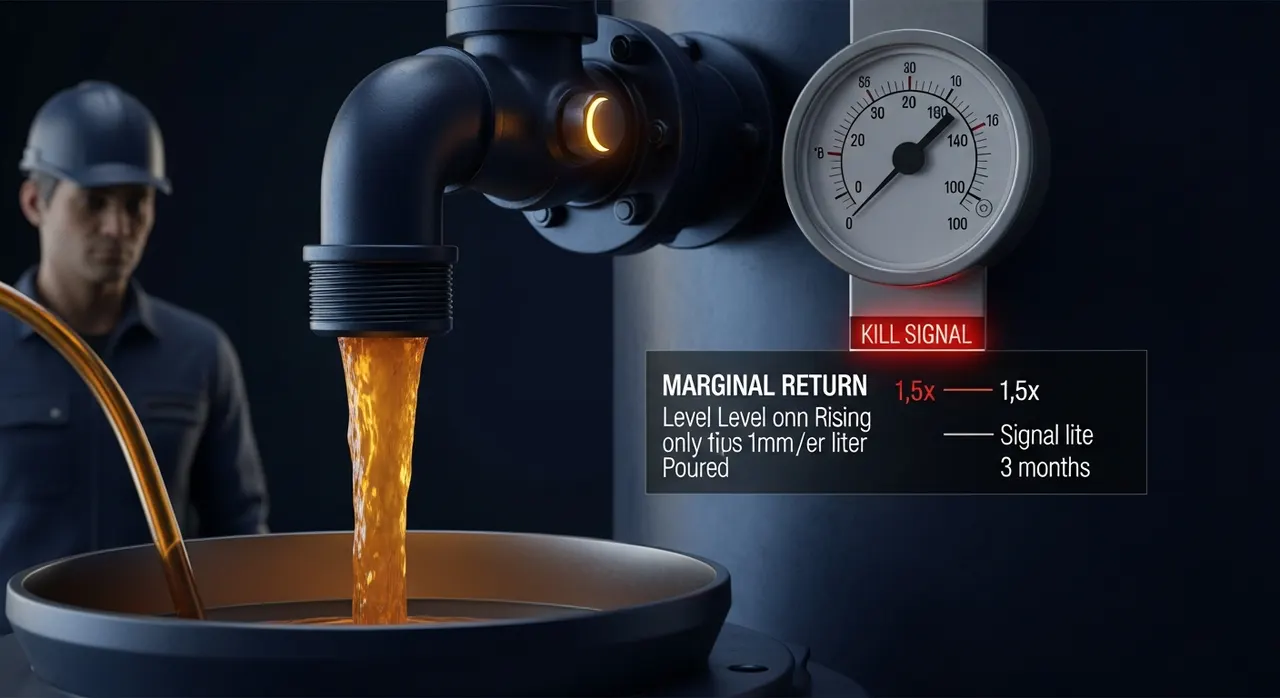
Before approving the next acquisition budget, ask: "If this channel doubled its price or died tomorrow, what would we keep?" If the answer is "nothing," you are not buying customers — you are renting access to them, and you should fund owned capture before another dollar of discovery. We treat this as a hard threshold in when to stop spending on acquisition and in the retention-versus-acquisition economics that determine whether scaling even makes sense.
What to do this week
- Pull your rented-to-owned conversion rate using the 90-day calculation above. Most operators have never seen this number. It is the most important one they don't track.
- Add an owned-capture step to your highest-traffic rented channel — an email or SMS capture in the post-purchase flow, with a reason to opt in beyond "10% off." If discovery is working but capture is missing, you are funding a leak.
- Set a floor, not a slogan. Decide the minimum share of acquisition budget that funds owned infrastructure (capture, email, loyalty), and protect it the way you protect inventory spend. The brands that survive the next repricing are the ones that treated owned reach as a line item before they were forced to.
Key Takeaway