By Diosh — Founder, AHAeCommerce | eCommerce decision intelligence for $50K–$5M GMV operators
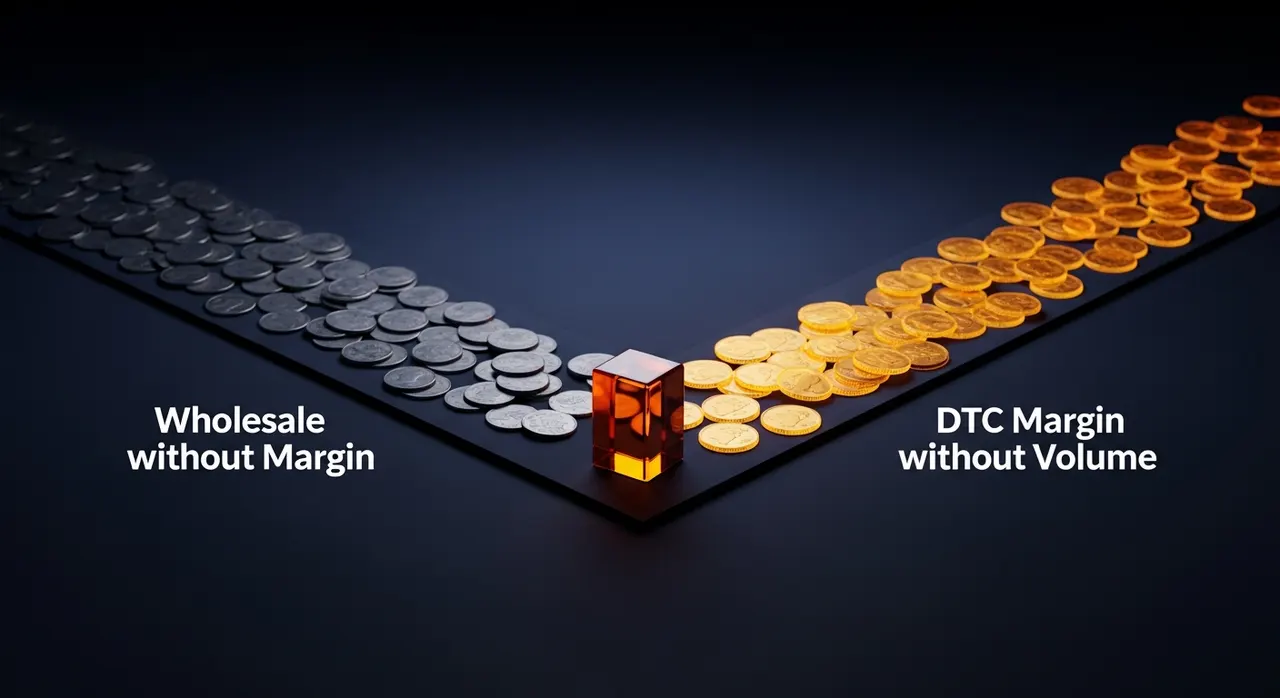
A brand selling a $80 retail item produces approximately $52 in gross profit at 65% margin selling DTC. The same item sold to a wholesale partner at the standard 50% off MSRP — $40 wholesale price — produces $12.40 in gross profit at the brand's $27.60 COGS. The wholesale unit produces 76% less gross profit per unit. But wholesale moves volume in single orders that DTC cannot match: a single boutique account averaging $4,000–$8,000 per quarter is the equivalent of 50–100 DTC orders without acquisition cost. The framing of "wholesale destroys margin" or "DTC means owning the relationship" is incomplete on both sides. The right question is not philosophical — it is which constraint the business is currently bound by, and what channel mix relaxes that constraint without breaking the others.
According to BoF Insights' 2023 retail report, the median DTC apparel brand at $1M–$5M revenue runs 60–80% DTC and 20–40% wholesale. Below $1M, brands are typically 90%+ DTC. Above $10M, the mix often inverts to 60%+ wholesale. The shape of the curve reflects the changing binding constraint at each stage.
What "Wholesale" and "DTC" Actually Mean Operationally
Both channels sell the same product. The operational and economic profile is meaningfully different.
DTC: Brand sells direct to consumer via owned channels (Shopify storefront, brand-owned marketplace). Brand controls pricing, customer experience, data capture, return policy, and merchandising. Brand pays full marketing cost, full payment processing, full fulfillment. Brand also captures full margin — typically 60–75% gross — and the customer relationship.
Wholesale: Brand sells to retailers (boutiques, department stores, specialty chains, Amazon Vendor Central) at a discounted price (typically 40–60% off MSRP). Retailer takes responsibility for marketing, customer experience, payment processing, and frontline customer service. Brand captures lower margin per unit but moves volume without per-unit acquisition cost.
The decision is not binary. Most brands run both channels in some mix. The question is the mix ratio at each stage.
The Four Binding Constraints
Every brand at every stage is bound by one of four constraints. The right channel mix is the one that relaxes the binding constraint without breaking the others.
Constraint 1: Margin
The brand needs more dollars per unit to fund operations. Symptoms: contribution margin per order below industry benchmarks, fixed cost coverage stress, working capital tightness.
When margin is the binding constraint: tilt DTC. Wholesale margin is structurally lower — adding wholesale volume to a margin-constrained brand makes the constraint worse, not better.
Exception: the wholesale relationship is a marketing investment (e.g., placing in a credibility-conferring retailer that drives DTC awareness). Then wholesale is loss-leader marketing, not core revenue, and is justified separately.
Constraint 2: Volume
The brand has product, capacity, and operational systems but cannot sell enough of it through DTC alone. Symptoms: inventory aging, marketing efficiency declining, CAC rising disproportionately to revenue growth.
When volume is the binding constraint: tilt wholesale. A single buyer at a regional chain placing a 1,500-unit order moves more volume in one purchase order than DTC moves in two months — at zero acquisition cost.
Exception: the brand's positioning is structurally DTC (premium, niche, brand-equity-forward) and wholesale would dilute the position. Then volume must come from DTC channel expansion (Amazon DTC, marketplaces) rather than traditional wholesale.
Constraint 3: Distribution
The brand needs physical presence in the customer's path-to-purchase. Symptoms: customers asking "where can I see/touch/try this?", competitive brands gaining share through retail visibility, the brand exists in DTC but lacks discovery.
When distribution is the binding constraint: wholesale is often the only path. DTC alone cannot create physical presence at scale. Strategic wholesale placement — even at low volume — produces awareness and discovery that DTC marketing cannot replicate.
Exception: the category is structurally non-physical-discovery (e.g., supplements, beauty refills, software-adjacent products). Then distribution constraint is solved through digital expansion (marketplaces, partnerships, content distribution).
Constraint 4: Data
The brand needs first-party customer data to fund retention, lifecycle marketing, and product development. Symptoms: high customer acquisition cost combined with low repeat rate, weak email/SMS list, no segmentation insight, poor product-market-fit signal because customer feedback is filtered through retailers.
When data is the binding constraint: tilt DTC. Wholesale customer data is structurally inaccessible — the retailer owns the relationship, and most retailers will not share customer data with the brand. Brands that allow >70% of revenue to flow through wholesale without a complementary DTC data strategy lose visibility into their own customer lifetime value and repeat purchase patterns.
Exception: the brand has data partnerships with key retailers (rare but possible at scale — Amazon Brand Analytics, some boutique retailers' sell-through reports). Then wholesale-driven data is partial but workable.
The Margin Math
Detailed comparison of DTC and wholesale economics on the same $80 retail product, $27.60 COGS:
DTC Per Unit
| Item | Value | |---|---| | Revenue | $80.00 | | COGS | ($27.60) | | Variable CAC ($24 blended) | ($24.00) | | Outbound shipping (operator absorbed at $50 free shipping threshold) | ($7.20) | | Payment processing | ($2.30) | | Fulfillment (3PL pick + pack) | ($2.40) | | Returns provision (24% rate × cost) | ($3.59) | | Customer service | ($0.76) | | DTC contribution per unit | $12.15 |
Wholesale Per Unit
| Item | Value | |---|---| | Wholesale price (50% off MSRP) | $40.00 | | COGS | ($27.60) | | Sales rep / wholesale account management (10% allocated) | ($1.50) | | Outbound freight to retailer (consolidated, lower per-unit) | ($0.80) | | Payment processing on wholesale (interchange-plus, 0.8%) | ($0.32) | | Wholesale returns provision (3-5% rate, retailer-driven) | ($0.40) | | Trade marketing / co-op contribution | ($1.20) | | Wholesale contribution per unit | $8.18 |
The wholesale unit produces 67% of the DTC contribution per unit ($8.18 vs $12.15) — meaningfully better than the headline gross profit comparison ($12.40 vs $52.40 = 24%) because wholesale eliminates most of the variable costs that DTC carries.
The full picture changes the strategic conclusion. "Wholesale destroys 76% of margin" is wrong; "wholesale produces 33% less contribution margin per unit but moves 5–20x more volume per buyer interaction" is right.
When the Math Inverts
For some brand profiles, wholesale produces more contribution than DTC. The conditions:
- Heavy/dimensional product: Outbound shipping eats DTC contribution. Wholesale shipping is consolidated and per-unit cheaper.
- High variable CAC: At $40+ blended CAC on $80 AOV, DTC contribution drops below wholesale.
- Low return rate but high return cost: Categories where the rare return is expensive (furniture, electronics) — wholesale shifts return risk to retailer.
- High returning customer rate via retail: Brands whose customers buy multiple times in physical retail but rarely repeat DTC due to category dynamics.
For brands matching these profiles, wholesale is not a margin sacrifice — it is the higher-contribution channel.
The Worked Decision: A $1.6M GMV DTC-Native Brand Considering Wholesale
Operator profile: skincare, $1.6M GMV, currently 95% DTC / 5% wholesale (gift shops, small boutiques), $42 AOV, $35 blended CAC, 1.4x repeat rate within 12 months.
The wholesale opportunity: a regional specialty retailer wants to place 8 SKUs across 22 stores. Initial PO: $48,000 wholesale ($96,000 retail equivalent), with potential for $180,000–$280,000 annualized if the placement performs.
The constraint analysis:
Margin: Brand contribution is healthy (32% per order); not bound. Volume: Brand is moving inventory at 4.2 turns/year, which is healthy; not bound. Distribution: Brand has zero physical retail presence, asked frequently "where can I see this?"; bound here. Data: Brand has 38,000 email subscribers, healthy retention systems; not bound.
Verdict: Distribution is the binding constraint. Wholesale at 5% of revenue is below the threshold where it would address the constraint meaningfully. A $48K initial PO scaling to $180K+/year would put the brand at 10-15% wholesale — meaningful for distribution without breaking DTC margin or data dynamics.
The implementation:
- Negotiate MAP (minimum advertised price) protection at $42 retail to prevent retailer discounting from undercutting DTC
- Reserve specific SKUs for wholesale (vs. full SKU overlap) to maintain DTC pricing/positioning differentiation
- Co-op marketing budget: 5% of wholesale volume reinvested in retailer-co-branded promotion (in-store demos, sampling)
- Cap initial geographic spread to 22 stores to prove the channel before expanding
The outcome (12 months later in this scenario): wholesale grew to 14% of revenue at $224K. DTC continued growing at 22% YoY (no cannibalization). Email list grew 18% from in-store sampling and QR codes driving DTC capture. Brand awareness in the regional market — measured by branded search volume — increased 41%.
This is the canonical wholesale-as-distribution play for a DTC-native brand. The mistake to avoid: opening wholesale to address volume constraint when distribution is what's actually binding (or vice versa). The constraints look similar from outside; the right channel design differs.
When Wholesale Is the Wrong Decision
Three conditions where wholesale is structurally wrong for a brand:
Condition 1: Brand Equity Strategy Requires Scarcity
Brands positioned around exclusivity, premium, or limited availability lose the positioning the moment the product is on a discount retailer's shelf. Wholesale placements at off-price (TJ Maxx, Marshalls, Nordstrom Rack) actively destroy brand equity — and once a brand's product appears at off-price, it is structurally difficult to remove.
Decision rule: If the brand's pricing and positioning depends on premium perception, wholesale must be carefully channel-selected (department store, specialty boutique only) and never include off-price.
Condition 2: Margin Cannot Absorb the Discount
Brands with COGS above 40% of MSRP cannot absorb the 50% wholesale discount and remain profitable. The wholesale price is below or near COGS.
Decision rule: Calculate (Wholesale price - COGS - operational cost) per unit. If under $3 per unit, wholesale is structurally uneconomic at standard discount levels. Negotiate higher wholesale price (40% off MSRP instead of 50%) or do not pursue the channel.
Condition 3: Brand Has No Operational Capacity for Wholesale
Wholesale is a different operational model: trade shows, sales rep relationships, EDI integration with retailers, dock-to-stock requirements, retailer compliance penalties (chargebacks for late ASN, missing UPC, packaging non-compliance). Brands without operational depth incur 5–15% of wholesale revenue in retailer chargebacks before they learn the compliance.
Decision rule: Budget for a wholesale operations FTE or partnership with a sales agency specializing in the category before pursuing wholesale at scale. Sub-$3M GMV brands should not pursue wholesale beyond a few small accounts without operational capacity in place.
The Channel Mix Curve
The empirically observed channel mix evolution for healthy brand growth:
| Stage | Revenue | DTC % | Wholesale % | Why | |---|---|---|---|---| | Early | <$500K | 95–100% | 0–5% | Margin and data are binding; wholesale operationally premature | | Growth | $500K–$3M | 75–90% | 10–25% | Volume and distribution begin binding; selective wholesale unlocks both | | Scale | $3M–$10M | 55–75% | 25–45% | Distribution becomes critical; wholesale supports it without DTC cannibalization | | Mature | $10M+ | 35–60% | 40–65% | Volume is the dominant constraint; wholesale provides scale efficiency |
The curve is not a prescription. Brands with strong premium positioning (Aesop, Glossier in early years) stay 90%+ DTC much longer. Brands with category dynamics that favor retail discovery (food, beverage, basics) shift to wholesale earlier. The constraint, not the stage, determines the mix.
The Verdict
Wholesale vs DTC is not a purity question. It is a constraint question. The brand currently bound by margin should stay heavily DTC. The brand bound by volume should add wholesale. The brand bound by distribution should pursue strategic retail placement. The brand bound by data should protect DTC dominance until data infrastructure is mature.
The mistake most operators make is choosing the channel mix based on aesthetic ("we're a DTC brand") rather than constraint analysis. Both channels have a place in a mature brand. The right ratio at any moment is the one that relaxes the binding constraint without breaking the others — and that ratio shifts as the business grows and the binding constraint changes.
This Week
Identify your binding constraint. Use the symptoms above: margin (contribution margin below benchmark), volume (inventory aging, declining marketing efficiency), distribution (customers asking where to find you physically), or data (high CAC + low repeat + weak first-party list). Once the constraint is named, the channel mix decision follows. Trying to optimize a channel mix without first identifying the constraint produces the wrong mix at every stage of growth.