By Diosh — Founder, AHAeCommerce | eCommerce decision intelligence for $50K–$5M GMV operators
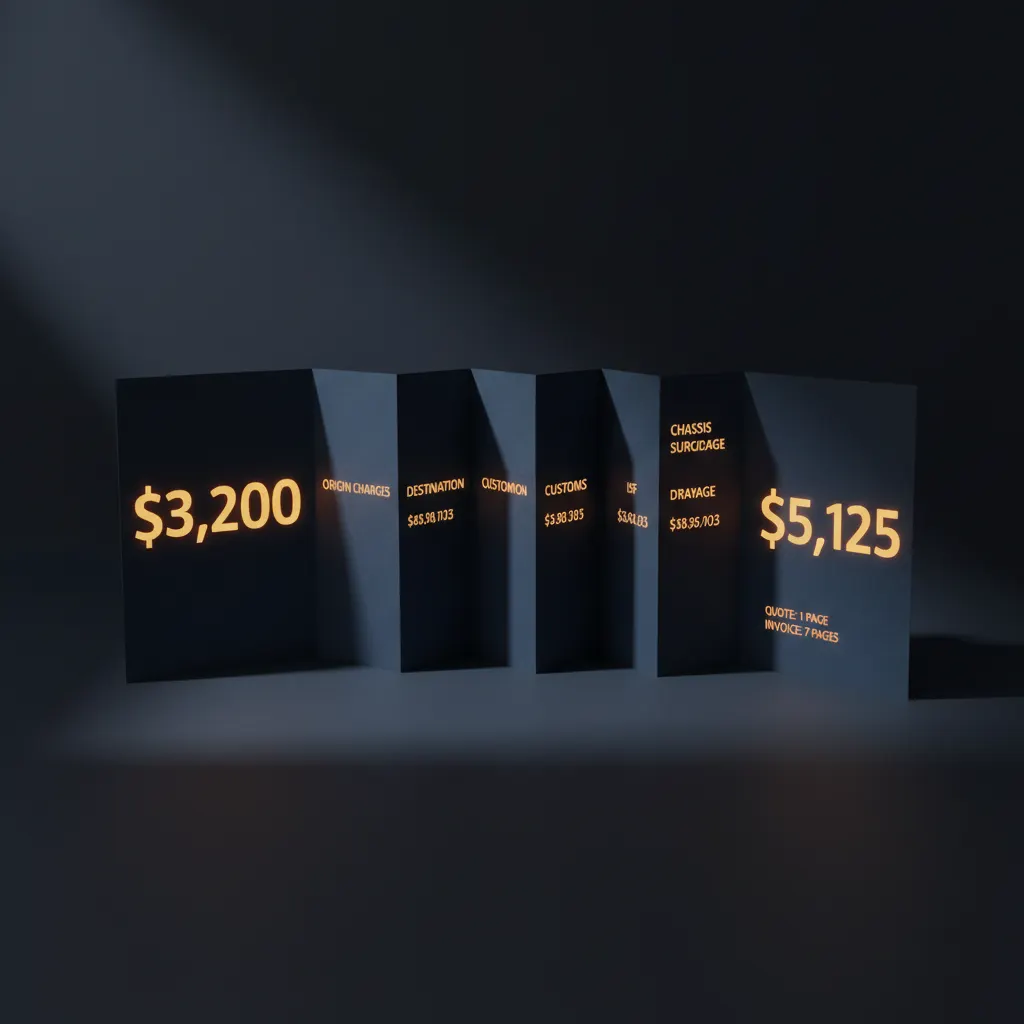
The $4,500 ocean quote sitting in your inbox is not the price of moving your container. It is the price of one of eleven line items, and on most invoices it is between 55% and 70% of what you actually pay. This is a cost piece for operators who have already been burned once — the wire transfer cleared, the goods arrived, and the final invoice was $3,000 higher than the quote. The mechanism is not fraud. It is the structure of how forwarders bid. After reading this, you will have a per-container cost stack you can demand before booking, a per-SKU landed cost number you can defend to your accountant, and one question that filters good forwarders from bad ones in under a minute.
Why The Ocean Quote Is The Only Number That Looks Cheap
Operators compare forwarders the way Kayak compares flights — by the headline number. Forwarders know this. The ocean freight leg is the single line item that is publicly indexed (the Freightos Baltic Index publishes it weekly), benchmarked against competitors, and shopped aggressively. As of mid-2026, Asia-to-US West Coast spot rates sit near $2,100 per 40-foot equivalent unit (Freightos, May 2026), which means a forwarder quoting you $2,400 has roughly a $300 spread on ocean. That is not where they make their money.
Where they make their money is everything that happens before the container is loaded in Yantian and everything that happens after it lands in Long Beach. Those line items are not indexed publicly. They are not standardized across forwarders. They are not on the quote you received. They are on the invoice that arrives six weeks later.
A $1.4M GMV home goods brand I worked with last year switched forwarders to save $600 per container on ocean. Their next invoice was $2,100 higher than the previous forwarder's average. The new forwarder had quoted ocean aggressively, then made it back on destination handling ($385), chassis per diem ($420), an ISF amendment fee ($150), and a "documentation fee" line that nobody could explain ($175). The operator did the right thing by comparing — they just compared the wrong number. This is the structural pattern explained in freight forwarding economics: margin lives in the unlit corners of the invoice.
The fix is not to negotiate the ocean leg harder. The fix is to demand the entire stack before you sign.
The Eleven-Line Cost Stack: What A $4,500 Quote Actually Becomes
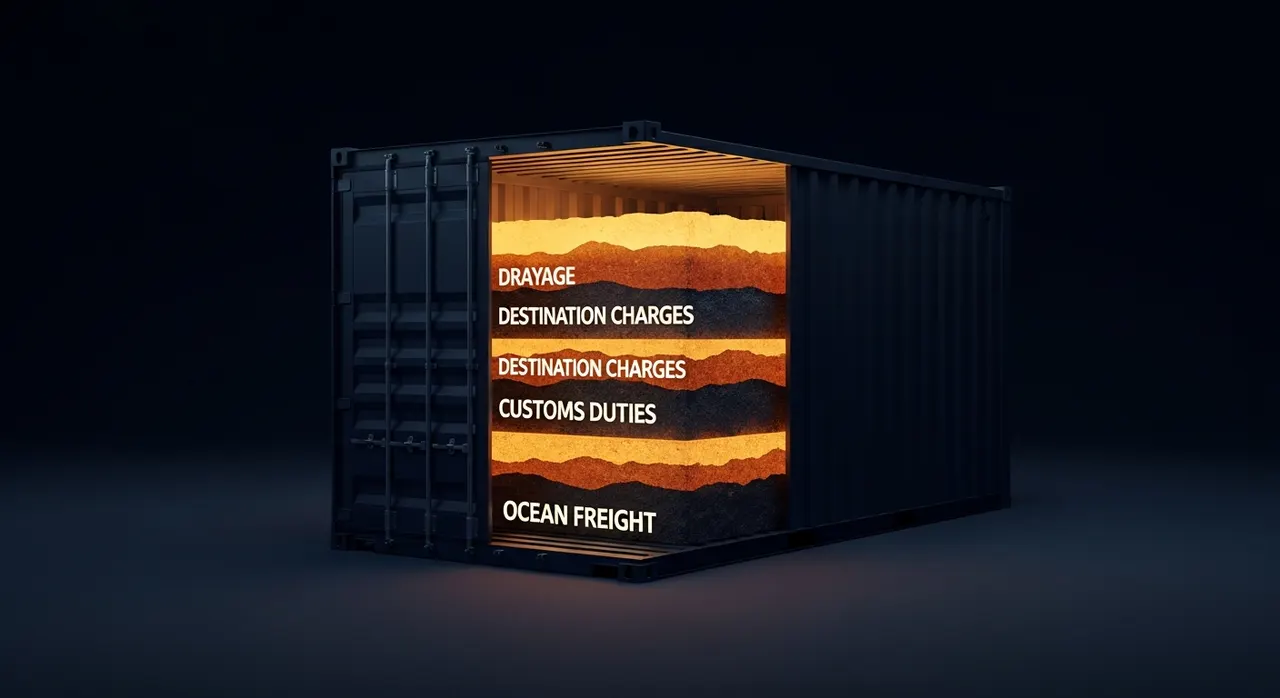
Here is the full cost stack for a single 40-foot container moving from a Yantian factory to a 3PL warehouse in Inland Empire, California. Ranges reflect what I have seen on actual invoices across roughly 40 import-heavy DTC operators in the $500K–$5M GMV band over 2024–2026. Your exact numbers will vary by lane, season, commodity HTS code, and forwarder.
1. Ocean freight (the quoted number)
This is the slot on the vessel. Currently $2,100–$2,800 per FEU on the transpacific eastbound lane, per the Freightos Baltic Index. Add bunker adjustment factor (BAF) and currency adjustment factor (CAF) — these float and are sometimes included in the quote, sometimes not. Ask explicitly.
2. Origin charges (THC, doc fee, telex release)
Terminal handling at origin runs $180–$320 per container. Documentation fee at origin: $50–$120. Telex release (so your goods are released without a physical bill of lading): $40–$75. Forwarder origin handling fee: $75–$150. Combined: roughly $350–$650 per container that often does not appear on the quote.
3. Destination charges (THC, doc fee, destination handling)
This is where the margin lives. Terminal handling at destination: $325–$485. Destination documentation fee: $65–$125. Destination handling fee: $125–$225. Wharfage and port security fees: $35–$95. Combined: $550–$930 per container. These are the line items most aggressively padded by forwarders who bid low on ocean.
4. ISF filing (Importer Security Filing, "10+2")
CBP requires the ISF 24 hours before vessel loading at the foreign port (CBP). Filing fee through your customs broker: $35–$80. Each amendment (if you change cartons, weights, or HTS codes): $20–$40. Late or missing filing penalty: up to $5,000 per violation. Most quotes show "ISF: included" — verify whether amendments are included or billed separately.
5. Customs broker entry fee
Single-entry: $125–$225 per shipment. Plus per-HTS-code charges if you have multiple classifications: $5–$15 per additional line. A continuous bond (which you need if you import more than once a year) costs roughly $400–$650 annually and is separate from the per-entry fee.
6. Merchandise Processing Fee (MPF) — paid to CBP
For fiscal year 2026, MPF on formal entries is 0.3464% of declared commercial value, with a minimum of $33.58 and a maximum of $651.50 per entry (CBP User Fee Table). On a container of $50,000 declared value, you hit the cap. On a container of $15,000 declared value, you pay $51.96. This goes to the government, not the forwarder — but it appears on your invoice as a pass-through.
7. Harbor Maintenance Fee (HMF) — paid to CBP
0.125% of declared value, applied to ocean shipments only (CBP). On $50,000 of declared value: $62.50. On $200,000: $250. No cap. This rate has not changed since 1987.
8. Duties (the variable nobody can predict for you)
Tariff rate × declared value. This varies by HTS code, country of origin, and current trade policy. The same commodity can carry a 0% Most Favored Nation rate and a 25% Section 301 surcharge stacked on top — and as covered in tariff shock, Section 301 lists change with little warning. Verify your HTS classification with your customs broker before importing. A misclassified container can carry $4,000+ in surprise duty.
9. Drayage (truck from port to warehouse)
LA/Long Beach to Inland Empire short-haul drayage: $475–$725 per container in 2026, plus fuel surcharge of $85–$140 (BookYourCargo, 2026 LA/LB drayage guide). Longer hauls or congested corridors run $900–$1,400.
10. Chassis fees
The most under-quoted line item in transpacific. Chassis daily rental: $35–$55 per day. Chassis split fee (if you have to pick up the chassis at a separate location from the container): $75–$165. Most operators expect 1–2 days of chassis use and get billed 4–7 because of port congestion. A $40/day rate becomes $280 fast.
11. Demurrage and detention (the silent killer)
Demurrage = container sitting at the port past free time (typically 3–7 days). Detention = container sitting at your warehouse past free time. 2026 rates run $150–$300/container/day for the first tier (days 1–5 past last free day) and $300–$500/day for the second tier (Port City Logistics, 2026 drayage guide). One stuck container during a port congestion week can add $1,500–$3,000 to your invoice. This is the line item that turns "we saved $600 on ocean" into "we paid $1,800 more total."
Stack total: a $4,500 ocean quote routinely becomes a $7,200–$9,500 invoice. The ocean leg is 55–70% of what you actually pay.
The Invoice Reconciliation: What A Real Final Bill Looks Like
Take the same container at midpoint estimates and walk it through:
- Ocean freight: $4,500
- Origin THC + doc + telex: $480
- Destination THC + handling + doc: $720
- ISF + amendment: $95
- Customs broker entry: $185
- MPF (on $40K declared value): $138.56
- HMF: $50.00
- Duties (assume 7.5% blended on $40K): $3,000
- Drayage + fuel surcharge: $625
- Chassis (3 days + split): $245
- Demurrage (1 day past LFD): $185
Total invoice: $10,223.56 — against a $4,500 quoted number.
Two-thirds of operators in the $500K–$5M GMV range I have advised see this exact gap and assume something went wrong. Nothing went wrong. This is what the actual cost of a container is. The quote was always going to be roughly half the invoice. The forwarder did not lie — they answered the only question you asked: "how much is the ocean?"
This is also why cross-border eCommerce cost modeling fails when operators benchmark themselves against headline freight rates. You are not buying ocean freight. You are buying delivered goods at a 3PL door, and the unit economics need to reflect that. As I argued in shipping strategy and margin impact, if landed cost is not in your COGS line, your gross margin number is fiction.
How To Force An All-In Quote Before You Book
The single question that filters good forwarders from bad ones:
"Send me an all-in landed cost estimate per container delivered to my warehouse, broken out by all eleven line items: ocean, origin charges, destination charges, ISF, customs broker entry, MPF, HMF, estimated duties at HTS [your code], drayage, chassis, and a demurrage assumption. Quote each line. Don't bundle."
A serious forwarder will produce this within 48 hours. A forwarder whose margin depends on hidden destination charges will resist — they will say "duties depend on classification" (true, but they can estimate), "destination is variable" (true, but they have a tariff sheet), or "we don't quote chassis upfront" (this means they are willing to surprise you). A forwarder who will not itemize is telling you, structurally, that they need the dark to be profitable.
What to verify on the itemized quote
- Origin charges: confirm whether telex release, AMS filing, and origin documentation are included
- Destination charges: ask specifically for THC, destination doc fee, destination handling, wharfage, and port security as separate lines
- ISF: confirm whether amendments are included (they usually are not)
- Customs broker entry: confirm per-HTS-code charges if you have more than 3 classifications
- Chassis: ask for the daily rate AND the typical day count for your destination port
- Demurrage: ask the forwarder to commit to an estimated free-time assumption based on current port dwell time at your destination
The negotiation leverage you did not know you had
Forwarders compete on ocean and protect destination. If you make destination the negotiation target, you get real movement. The pattern is similar to how a sharp procurement operator approaches supplier negotiation: negotiate the line items where information asymmetry favors the seller, not the ones where it is public. Ask for "destination THC capped at $X" or "chassis billed at port average not above $Y." Most forwarders will negotiate these — they just expect that you will not ask.
Building A Per-SKU Landed Cost Calculator
The output of all of this is a number you should know for every SKU you import: landed cost per unit at the 3PL door, before pick-pack. Without it, you are pricing on hope. With it, every other margin decision (paid acquisition spend, marketplace listing price, promotional discount floor) gets a defensible foundation.
The formula
For each SKU in a container:
Landed cost per unit =
  (FOB unit cost from supplier)
+ (Ocean freight / total units in container)
+ (Origin charges / total units)
+ (Destination charges / total units)
+ (ISF + broker entry + MPF + HMF / total units)
+ (Drayage + chassis + estimated demurrage / total units)
+ (Duty rate × FOB unit cost)
Note that ocean, origin, destination, drayage, and chassis are container-level costs that you amortize by unit count. MPF and HMF are percentage-of-value, so they scale with declared value, not unit count. Duty is per-unit-value. This matters: high-value, low-volume SKUs absorb proportionally more duty cost; low-value, high-volume SKUs absorb proportionally more freight cost.
Why most operators get this wrong
The common mistake is to amortize total freight cost evenly across all units in a container, regardless of value. That underprices the duty burden on high-value SKUs and overprices the freight burden on low-value ones. If you have a mixed-SKU container, run the calculation per SKU. Spreadsheet rows: SKU, FOB cost, HTS code, duty rate, units shipped, cubic feet, MPF/HMF share (by value), freight share (by volume), drayage share (by volume), per-unit landed cost.
A $1.8M GMV electronics accessory brand I advised re-ran this calculation across their top 40 SKUs after switching forwarders. Twelve of their SKUs had been priced at gross margins they thought were 47% and were actually 31% once chassis and demurrage were properly amortized. Two SKUs were losing money on Amazon at the price they had set. They raised prices on those two by $4–$6, killed two paid acquisition campaigns that depended on the false margin, and recovered roughly $11,000 of monthly contribution margin in 60 days. Nothing about their cost structure changed. Their visibility into it did.
Comparing Forwarders: The Right Metric Is Per Delivered SKU
The headline insight: never compare forwarders on ocean freight. Compare them on price per delivered SKU.
Run the same shipment scenario across two or three forwarders. Same factory, same destination 3PL, same product mix, same declared value. Force the itemized all-in quote from each. Then divide each forwarder's all-in total by the unit count of the container.
What you will discover, almost without exception: the forwarder with the lowest ocean quote is rarely the forwarder with the lowest per-delivered-SKU cost. In my data across operators who ran this comparison, the lowest-ocean-quote forwarder won the per-SKU comparison roughly 28% of the time. The other 72%, a mid-tier ocean quote with cleaner destination handling and lower chassis exposure beat them.
The three-forwarder protocol
- Pick three forwarders: one large NVOCC (Flexport, Maersk, etc.), one mid-market freight forwarder, and one regional specialist for your origin lane.
- Send each the same RFQ with all eleven line items required, an HTS code list, a destination 3PL address, and a target sailing window.
- Build a spreadsheet with one column per forwarder, one row per line item, plus a final row for per-delivered-SKU cost.
- Choose on per-SKU total. Verify on terms (free time at destination, chassis billing policy, demurrage threshold).
- Re-RFQ every six months. Forwarder margins drift up when accounts get stale.
This is the discipline that separates operators who treat freight as a fixed cost from operators who treat it as a negotiated input. The first group runs on quote-headline pricing and gets surprised quarterly. The second group runs on per-SKU landed cost and protects margin structurally.
What To Do This Week
If you have an open quote from a forwarder right now:
- Reply with the all-in itemized request above. Set a 48-hour deadline.
- Ask specifically for the chassis daily rate assumption and the demurrage free-time policy.
- Get a second itemized quote from a different forwarder using the same RFQ.
- Build the per-SKU landed cost spreadsheet for the top 10 SKUs in the container before you book.
- Set a calendar reminder for six months out: re-RFQ.
A quote that arrives without the eleven line items is not a quote. It is the first half of a conversation that ends, six weeks later, with an invoice that will be 35–80% higher. The cost is not hidden because forwarders are dishonest. It is hidden because you have not asked. Ask, in writing, before you sign.