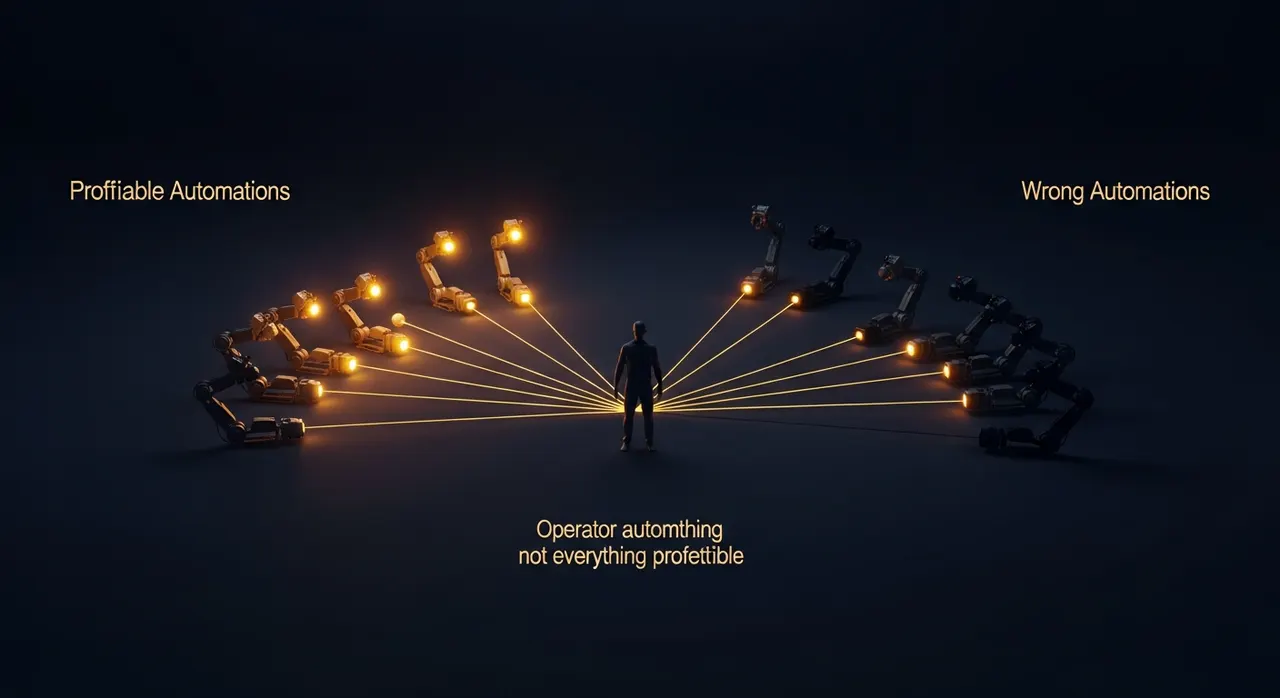
Operators automate the wrong things first. The instinct is to automate what is visible and annoying — answering common customer questions, posting to social media, generating product descriptions. These feel like wins. They rarely pass a rigorous cost test at the order volumes most eCommerce brands actually run.
The automation that pays for itself is unglamorous, high-volume, and repetitive: inventory sync, order routing, review request timing, abandoned cart sequencing. The average $500K eCommerce brand spends $4,000–$8,000 per year on automation tools (Gartner, "Magic Quadrant for Marketing Automation", 2023 — industry cost benchmarks) that produce measurable ROI on fewer than half of their active automations. The rest are complexity overhead dressed as efficiency.
The formula exists. Most operators do not apply it before purchasing.
The Default Assumption (and Why It Fails)
The pitch for every automation tool is "save time and scale." The assumption embedded in this pitch is that time saved equals money earned — that hours freed from manual work flow directly into revenue-generating activity. For founders and small teams, this is sometimes true. For operators with dedicated staff, it almost never is.
Time freed from automation is fungible in theory. In practice, it redistributes into meetings, email, and planning — not into incremental output. Unless the time saved from automation directly reduces payroll or directly increases throughput on a revenue-generating task, its dollar value is closer to zero than the tool's marketing suggests.
The second failure: operators estimate volume at aspiration, not reality. A tool that saves 10 minutes per order sounds transformative. At 200 orders per month, it saves 33 hours — meaningful. At 50 orders per month, it saves 8 hours — worth $200 at $25/hour in labor cost. If the tool costs $150/month, it earns $50/month in provable ROI. Most tools at this volume do not pass the test.
What the Decision Actually Hinges On
Order Volume Is the Multiplier
Every automation ROI calculation depends primarily on volume. A tool that saves 4 minutes per order generates:
- At 100 orders/month: 6.7 hours saved = $167/month at $25/hour
- At 500 orders/month: 33 hours saved = $833/month at $25/hour
- At 2,000 orders/month: 133 hours saved = $3,333/month at $25/hour
The tool's fixed cost does not change. Its ROI multiplies with volume. An operator at 100 orders/month considering a $299/month tool for order processing automation is losing $132/month until volume grows 3x. Most will not reach that threshold within the tool's 12-month contract.
Whether the Task Requires Human Judgment
Automation captures the value from rules-based, judgment-free tasks. The moment a task requires contextual interpretation — customer complaints, return exceptions, product recommendations for edge cases — automation reduces quality without reducing cost, because the error rate creates a human review layer that eliminates the time savings.
A chatbot handling "where is my order" queries at scale is automation. A chatbot handling "I received the wrong color and I'm furious" is a liability that still requires a human response, now delayed by the bot's failed attempt.
Setup and Maintenance Cost
The industry systematically underreports these. A Zapier automation that takes 3 hours to build and 30 minutes per month to maintain costs 21 hours of setup/maintenance time per year. At $50/hour for a competent operator, that is $1,050 in hidden labor before calculating tool cost. For a $49/month tool, this doubles the true annual cost.
The ROI Formula — With Two Worked Examples
The formula:
Monthly ROI = (Time saved per month × Hourly labor cost) + (Revenue impact per month)
            − (Tool monthly cost + Setup amortization + Monthly maintenance cost)
Where:
- Setup amortization = Total setup hours × hourly cost ÷ 12
- Monthly maintenance = Monthly upkeep hours × hourly cost
- Revenue impact = Direct lift attributable to automation (use zero if unproven)
Example 1: A tool that fails the test
Scenario: A $399/month AI-powered product description generator for a 500-SKU store.
- Time saved: 2 hours/month (descriptions still need human review and editing)
- Hourly labor cost: $35/hour
- Monthly time value: $70
- Revenue impact: Unproven (description quality improvement is not measured)
- Setup cost: 8 hours × $35 = $280 ÷ 12 = $23/month amortized
- Maintenance: 1 hour/month × $35 = $35/month
Monthly ROI = $70 + $0 − $399 − $23 − $35 = −$387/month
This tool costs $4,644/year net of any claimed benefit. The operator is paying for a tool that saves $840/year in labor while costing $5,484 in tool + overhead costs. It fails unless descriptions directly drive measurable conversion lift — which requires A/B testing the operator has not run.
Example 2: A tool that passes
Scenario: A $79/month automated review request tool for a brand at 600 orders/month with a current 3.2% organic review rate.
- Time saved: 4 hours/month (manual follow-up elimination)
- Hourly labor cost: $25/hour
- Monthly time value: $100
- Revenue impact: Review rate increases to 6.8% → 24 additional reviews/month. Each review increases conversion 0.3% on 4,000 monthly visitors at $65 AOV = $780/month in incremental revenue (conservative, based on Bazaarvoice 2023 conversion data for brands under 1,000 reviews)
- Setup cost: 2 hours × $25 = $50 ÷ 12 = $4/month amortized
- Maintenance: 0.25 hours/month × $25 = $6/month
Monthly ROI = $100 + $780 − $79 − $4 − $6 = +$791/month
This tool pays back its setup cost in week one of month one. At $791/month net, it generates $9,492/year in provable value at 600 orders/month.
The difference between these two examples is not price — the review tool costs less. It is volume leverage and measurable revenue impact. The description generator saves marginal time on a low-frequency task. The review tool operates on every order, every day, and directly influences purchase behavior.
Ranked Automation Categories by Payback Period at 500 Orders/Month
The following payback periods assume a mid-level tool in each category at the listed price point, with accurate volume and realistic time-saving assumptions.
| Automation Category | Typical Tool Cost | Monthly Labor Saved | Revenue Impact | Payback Period | |---|---|---|---|---| | Abandoned cart email sequences | $50–$150/mo | 3–5 hrs | $800–$2,400/mo (8–12% recovery rate) | Week 1 | | Post-purchase review requests | $50–$100/mo | 3–6 hrs | $400–$900/mo (conversion lift) | Week 2 | | Inventory low-stock alerts + reorder triggers | $80–$200/mo | 4–8 hrs | Stockout prevention ($500–$2,000/mo avoided) | Week 2–3 | | Order confirmation + shipping notification flows | $30–$80/mo | 2–4 hrs | Ticket deflection ($150–$400/mo) | Month 1 | | Return/exchange request routing | $100–$250/mo | 5–10 hrs | $250–$600/mo (labor reduction) | Month 1–2 | | Subscription billing retry logic | $0–$100/mo (often native) | 1–3 hrs | $300–$800/mo (churn prevention) | Month 1–2 | | Customer segmentation + tag automation | $50–$200/mo | 2–4 hrs | $200–$600/mo (email revenue lift) | Month 2–3 | | Social media scheduling | $30–$100/mo | 2–4 hrs | Near-zero (no direct revenue link) | Month 6–18 | | AI chatbot (general support) | $200–$600/mo | 3–6 hrs | Often negative at <2,000 orders/mo | Never (at this volume) | | AI product description generation | $100–$400/mo | 1–3 hrs | Unproven without A/B data | 24+ months or never |
The pattern is consistent: automations that touch every order or every customer action pay back fastest. Automations that replace creative or judgment-based work pay back slowly or not at all.
The Trade-Off Map
High-Volume, Rules-Based Automations
What you get: Compounding ROI. Every automation in the top four categories of the table above runs on every order, indefinitely, without marginal cost increase. At 500 orders/month today and 1,500 orders/month in 18 months, the same tool delivers 3x the value.
What you give up: Nothing material. These are not judgment tasks. The risk is configuration error — a mis-triggered abandoned cart email to someone who completed checkout, or a review request to a customer with an unresolved complaint. Invest 2 hours in proper segmentation logic before launch.
Judgment-Adjacent Automations
What you get: Time savings on routing and triage — not on resolution. Return routing automation, for example, removes the manual work of reading a return reason and assigning it to a queue. A human still resolves the return.
What you give up: Some accuracy. Rules-based routing misclassifies edge cases. At 500 orders/month with a 10% return rate, you process 50 returns. If 8% are misrouted, that is 4 returns per month requiring manual correction — roughly 30 minutes of rework. Factor this into your ROI calculation.
Creative and Content Automations
What you get: Speed. AI product description tools produce a first draft in seconds. Social scheduling tools remove the act of manual posting.
What you give up: Quality control you still have to provide. The tool does not eliminate the review step — it changes who does the initial draft. Unless you are producing at a volume where first-draft speed is the bottleneck (100+ new SKUs per month), this category rarely passes the ROI test.
A Decision Framework for What to Automate First
Apply this as a checklist before purchasing any automation tool:
Step 1: Quantify the task. How many times does this task occur per month? What does it cost in labor per occurrence? Monthly labor cost = occurrences × minutes per task ÷ 60 × hourly rate.
Step 2: Apply the volume test. If you triple your current order volume, does this task become a genuine operational problem? If yes, it is automation-eligible. If a human can still handle it at 3x volume, it is not a priority.
Step 3: Calculate breakeven volume. Breakeven orders = Tool monthly cost ÷ (Labor saved per order + Revenue impact per order). If your current volume is below breakeven, the tool costs money until you grow.
Step 4: Identify the revenue link. Can you measure the direct revenue impact of this automation within 90 days? If the answer is "probably" or "it should improve things," the revenue impact is zero in your calculation until you prove it. Use only the labor savings.
Step 5: Confirm the judgment requirement. Will errors require human review? Estimate your error rate and rework time. Subtract this from your time-savings estimate before calculating ROI.
If a tool passes all five steps, buy it. If it fails on step 2, 3, or 4, wait until your volume or measurement capability catches up.
When to Act
Automate a category when three conditions are simultaneously true:
-
The task occurs more than 200 times per month. Below this threshold, the ROI math rarely closes unless the task is exceptionally time-intensive.
-
You can measure the outcome within 90 days. Review rate, email revenue, cart recovery rate — these are measurable. Abandoned cart sequences recover 8–12% of abandoned carts on average (Klaviyo "Email Marketing Benchmarks", 2024), making them one of the few automations with a published recovery baseline you can benchmark against. "Brand perception" and "customer experience" are not measurable in the same way. If you cannot measure it, you cannot prove the ROI.
-
The tool costs less than 30% of the provable monthly labor savings. This gives you a 3x ROI buffer against your estimates being optimistic — and operator estimates are almost always optimistic.
What Operators Get Wrong Most Often
They count tools, not outcomes. The average eCommerce operator at $500K runs 12–18 SaaS tools. Fewer than half have been evaluated against the ROI formula. The rest are running on inertia, the founder's original enthusiasm, and the friction of cancellation. Run the formula on your current stack before adding anything new.
They automate to fix a process problem. A broken return process does not improve when you automate the routing. It becomes a faster broken process. Before automating any workflow, verify the manual version works correctly and consistently. Automation amplifies the underlying process — good or bad.
They calculate time saved as if it disappears. An employee who saves 5 hours per week through automation does not generate $125/week in value (at $25/hour) unless those 5 hours redirect to a defined, revenue-generating task. "Doing other things" is not a measurable output. If you cannot name the specific task the reclaimed time funds, do not count it as ROI.
They ignore the compounding cost of tool sprawl. Each tool adds integration maintenance, login overhead, and cognitive load. A team managing 18 tools spends approximately 3–5 hours per week in tool administration across the stack. At scale, simplification — replacing three tools with one integrated platform — often generates more ROI than adding a new automation.
Automation pays for itself when it runs on high volume, links to measurable revenue, and costs less than it saves. Everything else is paying for complexity.
The verdict: Before purchasing your next automation tool, run the ROI formula for your current top three tools. If any fail the test, cancel them this week. The money and the administrative overhead it frees is worth more than the marginal function the tool provides.